
www.industry-asia-pacific.com
03
'26
Written on Modified on
NEC and Mitsubishi Form Strategic Defense Technology Alliance
The partnership focuses on AI sovereignty, unmanned assets, and advanced command systems for Japan's national security.
www.nec.com
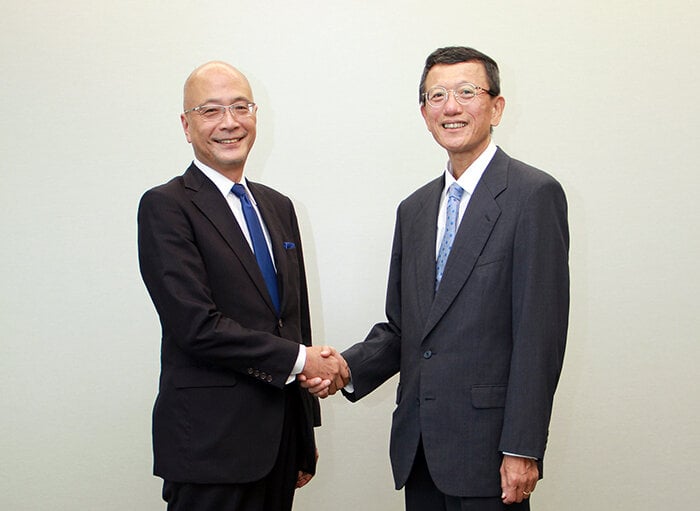
Hiroyuki Nagano, Corporate Executive Vice President and COO (Executive Officer), NEC Corporation (left) and Masayuki Eguchi, Corporate Executive Vice President, Chief of the Defense and Space Segment, Mitsubishi Heavy Industries, Ltd. (right)
NEC Corporation and Mitsubishi Heavy Industries (MHI) have signed a memorandum of understanding to establish a strategic partnership within the defense sector. The collaboration aims to reinforce Japan’s defense industrial base by focusing on advanced operation plans, command and control systems, and unmanned assets. A primary objective of the alliance is to establish strict data and AI sovereignty, ensuring highly reliable and secure operations for the country's national security framework.
As global security environments rapidly evolve, Japan's Ministry of Defense is actively transforming its capabilities to adapt to new methodologies of warfare. By integrating MHI's extensive expertise in defense equipment manufacturing with NEC's advanced cloud architecture and AI technologies, the partnership will accelerate the development cycle of next-generation defense systems. Executives from both companies emphasized that this domestic integration of cutting-edge technology will provide the robust, sovereign infrastructure necessary to sustainably support Japan's defense operations.
Additional Context
This section provides technological and market background not explicitly detailed in the original release.
The emphasis on "data and AI sovereignty" reflects a critical shift in global defense strategies. Modern warfare is increasingly network-centric, relying on the real-time fusion of data from satellites, drones, and ground sensors—similar to the U.S. military's Joint All-Domain Command and Control (JADC2) initiative. Relying on foreign cloud providers or AI models for this data processing poses significant national security risks, including potential exposure to foreign intelligence laws or supply chain vulnerabilities. By pairing MHI, Japan's largest defense contractor known for kinetic platforms like fighter jets and naval vessels, with NEC, a global leader in IT, biometrics, and secure networking, Japan aims to build a closed-loop, domestic military cloud ecosystem. This alliance directly supports the Japanese Ministry of Defense's ongoing strategic pivot toward prioritizing autonomous systems, cyber defense, and rapid, AI-assisted decision-making in the Indo-Pacific region.
Edited by Lekshman Ramdas, Induportals editor – adapted by AI.
www.nec.com
NEC Corporation and Mitsubishi Heavy Industries (MHI) have signed a memorandum of understanding to establish a strategic partnership within the defense sector. The collaboration aims to reinforce Japan’s defense industrial base by focusing on advanced operation plans, command and control systems, and unmanned assets. A primary objective of the alliance is to establish strict data and AI sovereignty, ensuring highly reliable and secure operations for the country's national security framework.
As global security environments rapidly evolve, Japan's Ministry of Defense is actively transforming its capabilities to adapt to new methodologies of warfare. By integrating MHI's extensive expertise in defense equipment manufacturing with NEC's advanced cloud architecture and AI technologies, the partnership will accelerate the development cycle of next-generation defense systems. Executives from both companies emphasized that this domestic integration of cutting-edge technology will provide the robust, sovereign infrastructure necessary to sustainably support Japan's defense operations.
Additional Context
This section provides technological and market background not explicitly detailed in the original release.
The emphasis on "data and AI sovereignty" reflects a critical shift in global defense strategies. Modern warfare is increasingly network-centric, relying on the real-time fusion of data from satellites, drones, and ground sensors—similar to the U.S. military's Joint All-Domain Command and Control (JADC2) initiative. Relying on foreign cloud providers or AI models for this data processing poses significant national security risks, including potential exposure to foreign intelligence laws or supply chain vulnerabilities. By pairing MHI, Japan's largest defense contractor known for kinetic platforms like fighter jets and naval vessels, with NEC, a global leader in IT, biometrics, and secure networking, Japan aims to build a closed-loop, domestic military cloud ecosystem. This alliance directly supports the Japanese Ministry of Defense's ongoing strategic pivot toward prioritizing autonomous systems, cyber defense, and rapid, AI-assisted decision-making in the Indo-Pacific region.
Edited by Lekshman Ramdas, Induportals editor – adapted by AI.
www.nec.com
