
www.industry-asia-pacific.com
05
'26
Written on Modified on
Quantum Computing Framework for Targeted Neoantigen Sequence Optimization
NEC and Taiho Pharmaceutical are developing a computational infrastructure to evaluate amino acid sequences for targeted oncological immunotherapies.
www.nec.com
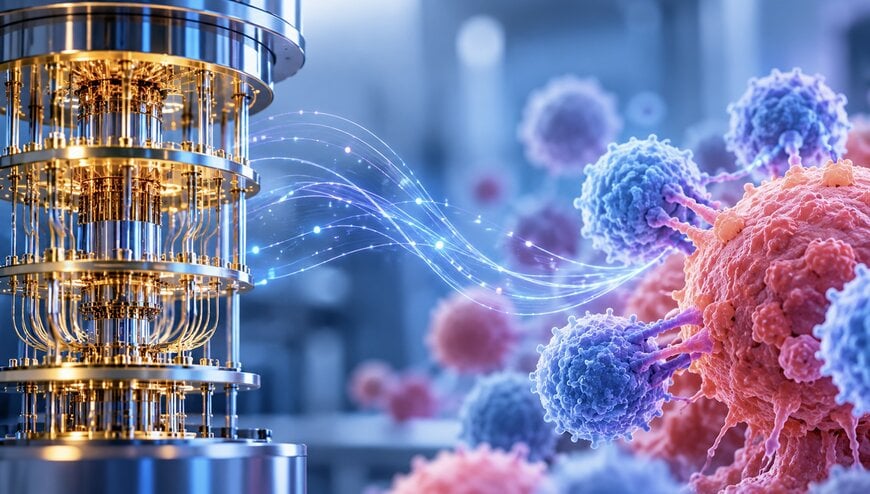
NEC Corporation, Taiho Pharmaceutical Co., Ltd., the Japanese Foundation for Cancer Research (JFCR), the National Institute of Advanced Industrial Science and Technology (AIST), and Waseda University have initiated a joint research project to establish a computational platform for cancer immunotherapy. The collaboration utilizes quantum computing and artificial intelligence to design and validate neoantigen candidates for oncological drug discovery applications.
Interdisciplinary Collaboration for Oncological Targeting
The consortium addresses a primary structural bottleneck in cancer immunotherapy: the precise identification and optimization of neoantigens that trigger targeted immune responses. Neoantigens, which arise specifically in cancer cells, are presented on the cell surface by major histocompatibility complex (MHC) molecules. Eliciting CD4-positive T-cell responses through MHC class II molecules is critical for activating other immune cells and sustaining antitumor immunity. However, predicting the necessary amino acid sequence characteristics, MHC class II binding affinities, and cell surface presentation mechanics requires evaluating an exceptionally large combinatorial space. Managing this biological and computational complexity necessitates a cooperative approach that combines corporate computational infrastructure, pharmaceutical development frameworks, and specialized academic immunological research.
Sequence Optimization via Hybrid Computational Architectures
The technical solution operates by integrating artificial intelligence with quantum computing to manage multifactorial sequence design. Within this architecture, artificial intelligence algorithms predict and score the potential immune responses of various neoantigen candidates. Concurrently, quantum computing algorithms calculate the optimal amino acid sequences flanking the neoantigen core region. This approach allows the system to process a volume of sequence combinations and binding variables that exceeds the capacity of classical computational models, enabling the systematic generation of sequence candidates with high predicted immunogenicity.
Infrastructure Integration and Experimental Validation
Scheduled to operate from September 2026 to March 2029 under a demonstration program administered by Japan’s New Energy and Industrial Technology Development Organization (NEDO), the project relies on the ABCI-Q computing infrastructure developed by AIST. This hardware environment natively integrates quantum processing, high-performance computing (HPC), and artificial intelligence systems. Following the computational generation of neoantigen sequences, researchers will conduct physical immunological experiments to validate the predicted T-cell responses. The empirical data generated from these validations will then be fed back into the computational models, creating an iterative machine-learning pipeline that refines the initial artificial intelligence scoring parameters based on physical laboratory outputs.
Process Stability in Drug Discovery
The primary application of this platform is the acceleration of the drug discovery pipeline for targeted immunotherapies. By replacing sequential, trial-and-error laboratory synthesis with quantum-accelerated computational screening, the consortium aims to isolate viable therapeutic targets with higher accuracy. This closed-loop mechanism of computational design and experimental feedback is designed to stabilize the early phases of oncological drug development, reducing the total time and resources required to identify highly immunogenic neoantigen sequences for further therapeutic development.
Edited by Aishwarya Mambet, Induportals Editor, with AI assistance.
www.nec.com
