
www.industry-asia-pacific.com
14
'26
Written on Modified on
NEC Starts Orbital Transfer Vehicle Development Program
JAXA-backed project targets satellite transport systems while aiming for Asia’s first Orbital Transfer Vehicle deployment.
www.nec.com
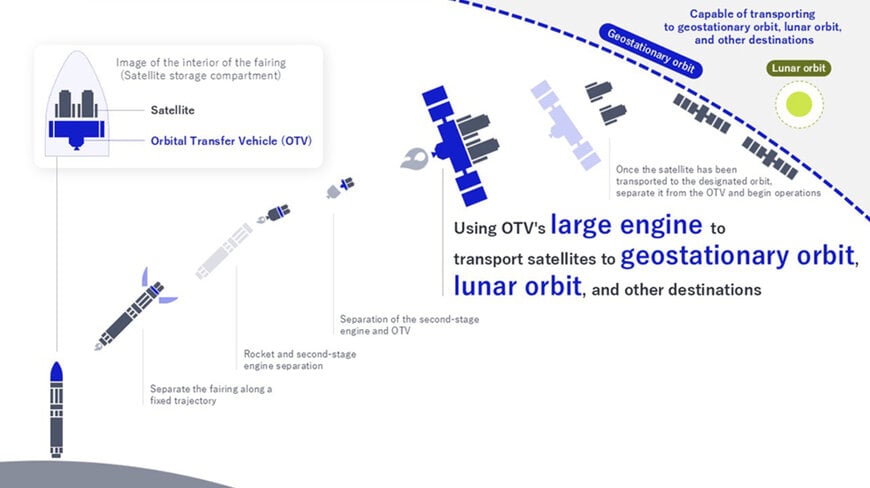
NEC Corporation has launched a development program for an Orbital Transfer Vehicle following its selection under the Japan Aerospace Exploration Agency Space Strategy Fund initiative. The project focuses on developing inter-orbital transportation technology designed to transfer satellites from initial deployment orbits to operational destinations such as geostationary orbit and cislunar space.
According to NEC, the program aims to achieve Asia’s first deployment of an Orbital Transfer Vehicle. The initiative forms part of broader efforts within the space industry to expand orbital mobility infrastructure and improve access to higher-energy orbital environments for commercial and scientific spacecraft.
Orbital transfer systems for satellite deployment
An Orbital Transfer Vehicle is designed to transport satellites after separation from launch rockets. In conventional launch operations, satellites often rely on onboard propulsion systems and significant fuel reserves to move from initial insertion orbit to final operational orbit.
OTVs are intended to reduce this requirement by performing orbital transfer operations independently. This can allow smaller satellites with limited propulsion capability to access destinations such as geostationary orbit or lunar transfer trajectories.
The approach is also intended to improve launch and deployment efficiency by transporting multiple satellites simultaneously within a single transfer mission. Such systems are increasingly being evaluated as satellite operators seek more flexible deployment options for commercial communications, Earth observation, and deep-space missions.
Expanding orbital mobility infrastructure
Orbital mobility is becoming an increasingly important segment within the global space economy as satellite deployments expand across low Earth orbit, geostationary orbit, and cislunar regions between Earth and the Moon.
Cislunar space is expected to play a growing role in future lunar exploration, communications infrastructure, scientific missions, and space logistics operations. Transfer vehicle systems may support these activities by reducing propulsion requirements for individual spacecraft and enabling more modular mission architectures.
According to NEC, broader use of OTV systems could lower barriers to space utilization and encourage participation from additional commercial operators entering the space sector.
Spacecraft development experience and project roadmap
NEC stated that the project builds on more than 50 years of spacecraft development experience, including work on the Kizuna communications satellite, the Kaguya lunar orbiter, and the Hayabusa2 deep-space mission.
The company plans to conduct market feasibility studies, conceptual system design, and demonstration activities through the end of fiscal year 2027. These activities are intended to define operational requirements and technical specifications for the transfer vehicle platform.
Development of a demonstration model is scheduled to begin in fiscal year 2028, followed by launch and in-space testing targeted for fiscal year 2032.
Space logistics and orbital transfer systems typically require advanced propulsion, autonomous navigation, orbital rendezvous capability, and long-duration spacecraft operation technologies. Such systems are increasingly viewed as foundational infrastructure for future multi-orbit space transportation networks.
Competitive context in orbital transfer technology
Orbital transfer vehicles are becoming an active area of development within the global aerospace sector as satellite launch frequency increases and missions expand beyond low Earth orbit.
Comparable systems internationally are generally evaluated based on payload transport capacity, propulsion efficiency, orbital maneuver capability, mission flexibility, and ability to support multi-satellite deployment operations. The growing demand for in-space transportation services is also linked to expansion of commercial satellite constellations and future lunar exploration initiatives.
NEC stated that its long-term objective is to develop highly competitive orbital mobility systems capable of supporting both commercial space utilization and scientific exploration activities.
Edited by Natania Lyngdoh, Induportals editor, with AI assistance.
www.nec.com
