
www.industry-asia-pacific.com
08
'26
Written on Modified on
Fraunhofer IPMS Develops Highly Sensitive Infrared Sensors
By integrating highly efficient thermoelectric materials into CMOS-compatible manufacturing technology for the first time, the project aims to create significantly more powerful sensors.
www.fraunhofer.de
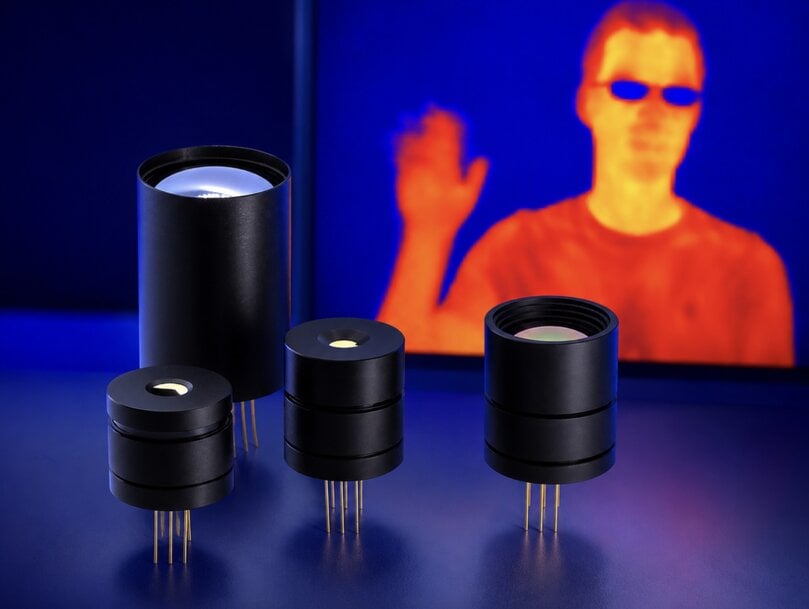
The Fraunhofer Institute for Photonic Microsystems (IPMS), in collaboration with Heimann Sensor and the Leibniz Institute for Solid State and Materials Research Dresden (IFW Dresden), is developing the technological foundation for a new generation of thermoelectric infrared sensor arrays. By integrating highly efficient thermoelectric materials into CMOS-compatible manufacturing technology for the first time, the project aims to create significantly more powerful sensors. The goal is to achieve a temperature resolution of less than 20 millikelvin with pixel sizes of less than 45 micrometers, which is an important step toward new applications in medicine, industry, mobility and security.
Thermoelectric infrared sensors enable noncontact temperature measurement and the generation of thermal images. They are already in use today in process monitoring, building automation, and security technology. However, the performance of current systems is limited by the thermocouple materials used. The new project addresses this challenge by employing significantly more efficient thermoelectric materials and a novel MEMS device concept.
New Applications Thanks to Higher Sensitivity
The goal of improving temperature resolution opens up numerous new areas of application. In the medical field, future applications could be developed to support early cancer detection or the detection of externally visible inflammation. In the context of senior living, the sensors also enable new solutions, such as the reliable detection of falls or emergency situations in the home.
Furthermore, autonomous vehicles benefit from the higher sensitivity of the sensor arrays. For industrial applications, new possibilities are opening up in thermography and process monitoring. In addition, the use of these sensors in cost-effective solutions for contactless temperature measurement opens the door to further application and market segments.
MEMS Technology for the Integration of Novel Materials
Fraunhofer IPMS is taking on key roles in the project’s development of MEMS technology. This includes the integration of novel thermocouple layers, the development and optimization of the necessary manufacturing processes, and the production of demonstrator chips. In addition, strategies are being developed to integrate the new materials into the institute’s 200-mm production line in the future.
The project partners will initially demonstrate the developed technologies using passive sensor arrays. In a subsequent development phase, these will be used to create active sensor arrays with integrated CMOS drive electronics. The goal is to achieve a technology readiness level (TRL) of 4 with the demonstrators developed in the project.
Additional Context
This section details technical specifications not included in the original news release.
The implementation of a Motor Protective Switching Device (MPSD) like the 140ME involves replacing traditional three-component motor starters—comprising a separate manual disconnect switch, short-circuit branch fuses, and an electromechanical thermal overload relay—with an integrated solid-state unit. In compliance with international standards, the 140ME utilizes a combination of mechanical contacts and microprocessor-controlled measurement transformers to provide precise, adjustable protection parameters. The electronic overload sensing circuitry monitors current waveforms continuously across all three phases; if an asymmetric drop occurs, signifying a phase loss condition, the electronic trip unit acts within milliseconds to prevent localized stator winding overheating, a common failure point in three-phase induction motors.
Integrating these devices into a digital network relies on a Single-Pair Ethernet backbone built directly into the control panel's rail infrastructure. Traditional in-cabinet components require dedicated point-to-point digital and analog input/output wiring routed back to centralized input modules, creating extensive labor overhead and potential wiring errors.
The EtherNet/IP In-cabinet Solution replaces this layout with an ODVA-certified flat media cable that distributes both 24V DC control power and high-speed industrial Ethernet communication across a single bus. The 100-E Contactor communication module functions as a local network gateway, reading internal data registers from the attached 140ME device—including historical trip logs, percentage thermal utilization, phase current imbalances, and contact wear indicators. This data is transferred natively via Common Industrial Protocol (CIP) objects into studio design software using specialized Add-On Profiles, enabling synchronous automation control and asset management loops without adding extra field transceivers.
Edited by Romila DSilva, Induportals Editor, with AI assistance.
www.ipms.fraunhofer.de
