
www.industry-asia-pacific.com
23
'26
Written on Modified on
Autonomous Air Mobility Systems at Singapore Airshow
Boeing and Wisk will showcase autonomous air mobility technologies at the Singapore Airshow, 3–8 February 2026.
www.boeing.com
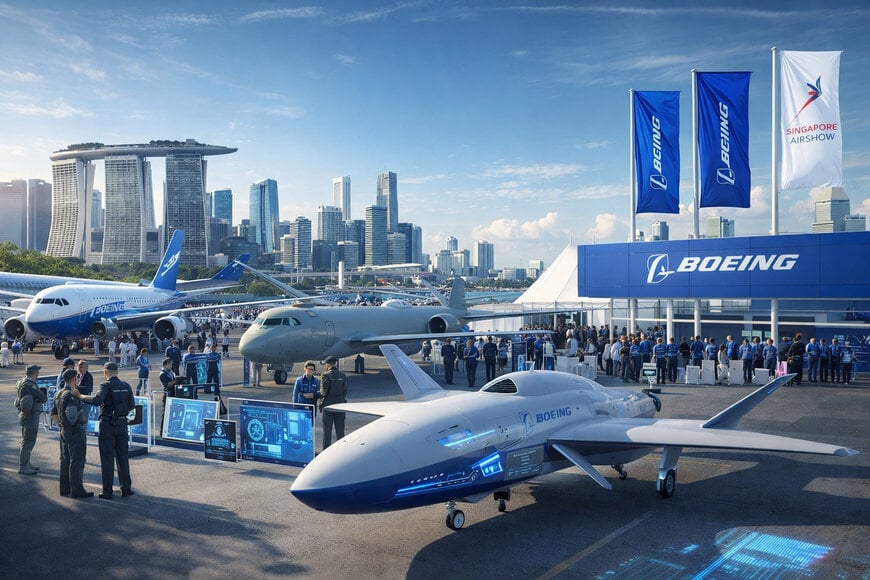
Boeing and Wisk will cooperate at the Singapore Airshow in February 2026 to demonstrate how autonomous electric aircraft can be integrated into broader aerospace autonomy architectures. The collaboration focuses on advanced air mobility and unmanned systems for civil and defense-related aerospace applications.
Context of the Cooperation
Boeing operates across commercial aviation, defense, space, and autonomous systems, while Wisk develops autonomous, all-electric vertical take-off and landing (eVTOL) aircraft for urban and regional mobility. The cooperation addresses a key industrial challenge: aligning emerging autonomous air mobility platforms with established aerospace systems, operational concepts, and regulatory frameworks.
At the Singapore Airshow (3–8 February 2026), Boeing will highlight autonomy as a cross-cutting capability spanning commercial, defense, and future air mobility domains. Wisk’s participation supports this objective by providing a concrete autonomous aircraft platform that illustrates system-level integration issues, including autonomy assurance, human–machine interaction, and airspace compatibility.
Technical Solution and Responsibilities
The technical focus of the cooperation is the inclusion of Wisk’s Gen 6 autonomous eVTOL air taxi within Boeing’s autonomy exhibit. The Gen 6 aircraft uses distributed electric propulsion and an autonomous flight control system designed for routine, pilotless operations under evolving civil aviation certification frameworks.
Wisk is responsible for the Gen 6 aircraft architecture, including autonomy software, flight control redundancy, and electric propulsion design. Boeing will provide the systems context, positioning the Gen 6 platform alongside its existing autonomous products and demonstrating how autonomous aircraft can interface with broader command-and-control, simulation, and data environments.
The exhibit will emphasize system interoperability, including autonomy supervision concepts, sensor fusion workflows, and integration with digital engineering and simulation tools rather than flight performance alone.
Deployment and Implementation
The cooperation will be implemented through a static and immersive exhibit at the airshow. Boeing plans to use visualization and virtual-reality tools to allow technical audiences to examine autonomous flight scenarios, control logic, and cabin-level human–machine interfaces associated with the Gen 6 platform.
Wisk will support the deployment with technical data and engineering expertise, while Boeing will manage exhibit integration, simulation environments, and systems-level contextualization. The implementation is intended to support technical evaluation and discussion rather than operational deployment.
Applications and Use Cases
The collaboration targets advanced air mobility, autonomous passenger transport, and unmanned aerial operations. Use cases include autonomous route planning, detect-and-avoid system integration, and energy management for electric propulsion within controlled and mixed airspace environments.
Expected Impact
While no quantitative performance data are disclosed, the cooperation is expected to clarify how autonomous eVTOL systems can be incorporated into existing aerospace autonomy frameworks. By presenting Wisk’s Gen 6 aircraft within Boeing’s portfolio, the collaboration provides a structured, technical reference for scalability, certification alignment, and system integration challenges in autonomous aviation.
www.boeing.com
