
www.industry-asia-pacific.com
27
'26
Written on Modified on
Arkannect launches hybrid inverters and LFP battery storage
The Made-in-India 3 kW inverter and 5.12 kWh battery target residential solar adoption and energy independence.
www.arkannect.com
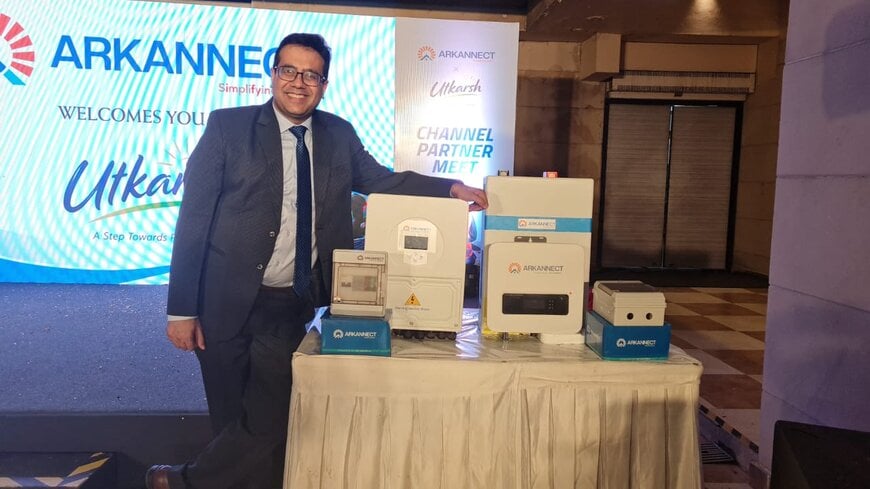
Arkannect, a distributed solar platform and subsidiary of AB Energia, has launched its initial portfolio of hybrid inverter and battery storage solutions tailored for residential and small business customers in India. The system features a 3 kW hybrid inverter paired with a 5.12 kWh lithium iron phosphate (LFP) battery, which is assembled domestically using imported cells. Rolling out initially across Maharashtra, Kerala, Uttar Pradesh, and Madhya Pradesh, the company aims to generate ₹225 crore in revenue during its first year of operation.
Integrated solar and energy storage
As decentralized solar adoption grows, the ability to store energy for use beyond daylight hours has become critical for maximizing return on investment. Arkannect’s 5.12 kWh LFP battery is designed for long-term reliability, offering an expected lifecycle of approximately 6,000 cycles and backed by a 10-year warranty. To streamline the transition to solar energy, the company provides an end-to-end service model that encompasses installation, financing, and maintenance, all managed through a centralized, app-based customer interface.
Market expansion and revenue targets
Targeting underserved Tier 2 and Tier 3 markets, Arkannect plans to reach 15,000 households and scale its revenue to ₹1,000 crore within three years. According to Sagar Saxena, CEO of Arkannect, integrating energy storage gives consumers the flexibility needed to bridge the gap between peak solar generation and peak evening consumption. By offering performance assurance and comprehensive lifecycle support, the company aims to simplify the adoption process and build long-term consumer confidence in distributed solar architecture.
Additional Context: LFP chemistry in residential energy storage
This section details battery electrochemistry and thermal dynamics not included in the original press release.
In the residential energy storage market, Lithium Iron Phosphate (LFP) chemistry has rapidly become the preferred standard, largely displacing Nickel Manganese Cobalt (NMC) formulations. While NMC batteries offer higher energy density (making them ideal for electric vehicles where weight and space are premium constraints), LFP batteries provide superior thermal stability and safety. In high-ambient-temperature environments like India, LFP cells are significantly less prone to thermal runaway and combustion. Furthermore, LFP chemistry degrades at a much slower rate under daily deep discharge cycles. This resilience to degradation is what allows stationary storage systems to achieve the 6,000-cycle lifespan necessary to make a 10-year warranty economically viable for daily solar charging and discharging applications.
Edited by an industrial journalist, Lekshman Ramdas, with AI assistance.
www.arkannect.com
