
www.industry-asia-pacific.com
02
'26
Written on Modified on
High-Head Hydropower Turbines for Himalayan Clean Energy Infrastructure
ANDRITZ secured a contract to manufacture four Pelton turbine-generator units for the 600 MW Khorlochhu hydropower facility in Bhutan.
www.andritz.com
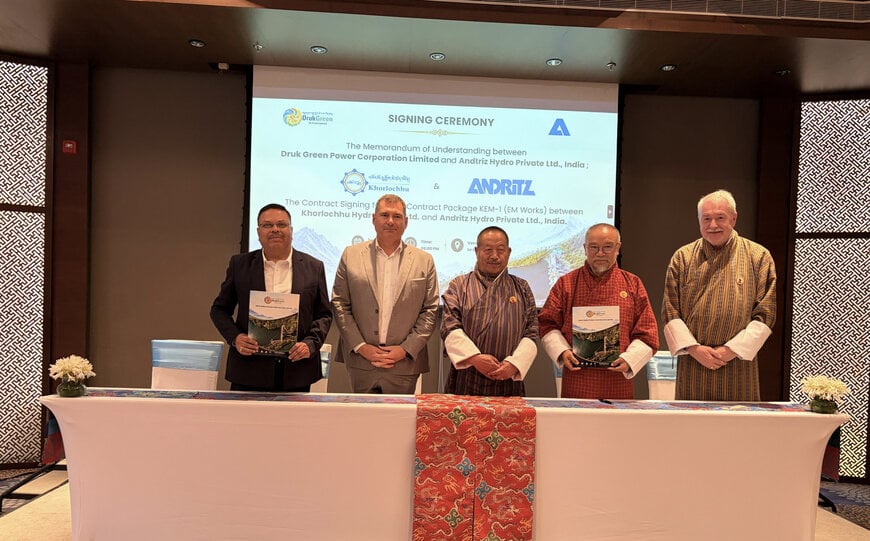
Developing run-of-the-river hydroelectric power in mountainous Himalayan topography presents severe geotechnical and hydraulic challenges, requiring turbomachinery capable of withstanding extreme hydrostatic pressures and high water velocities. Khorlochhu Hydro Power Limited addressed these generation requirements by selecting international technology group ANDRITZ to supply four complete turbine-generator units and associated electromechanical systems for the 600 MW Khorlochhu hydropower project in the Trashiyangtse District of eastern Bhutan.
Hydrodynamic Conversion and Pelton Runner Architecture
Hydraulic power generation across high-head river valleys relies on impulse conversion mechanisms rather than reaction turbines. While reaction designs like Francis or Kaplan turbines operate within water-filled enclosures at moderate pressures, high-head installations require Pelton impulse turbines to manage dynamic water velocity without cavitation damage.
Under this contract, valued in the upper double-digit million-euro range and booked in the second quarter of 2026, ANDRITZ will execute the design, fabrication, supply, installation, testing, and commissioning of four Pelton turbine units along with matching synchronous generators, auxiliary equipment, and balance-of-plant systems. In operation, high-pressure water conveyed through deep underground pressure shafts discharges through calibrated needle nozzles, converting static pressure into high-velocity water jets directed against double-cupped Pelton buckets. This continuous kinetic momentum transfer drives the rotor shaft and synchronous generator without exposing the mechanical drivetrain to irregular pressure waves.
Regional Manufacturing and Joint-Venture Project Integration
Manufacturing execution will leverage ANDRITZ facilities in India, supported by the group's international engineering network. This regional fabrication approach provides logistical proximity to eastern Bhutan, simplifying heavy transport through mountain corridors.
Khorlochhu Hydro Power Limited functions as a joint venture between Druk Green Power Corporation Limited and India-based Tata Power Company Limited. Representatives of the joint venture noted that the equipment partnership supports Bhutan's long-term green power expansion and sustainability goals. The project expands ANDRITZ's operational base in Bhutan, where the technology supplier maintains several active generation projects and operates Bhutan Automation & Engineering Ltd, an established joint-venture entity co-owned with Druk Green Power Corporation Limited.
Grid Contribution and Renewable Base-Load Generation
Electricity generation forms the structural foundation of the Bhutanese economy, serving both domestic grid stabilization and regional export pipelines to neighboring energy markets. The 600 MW Khorlochhu plant represents one of Bhutan's largest ongoing civil energy undertakings, engineered to generate approximately 2.524 terawatt-hours of renewable electricity annually.
The integration of four discrete turbine-generator sets permits variable dispatch flexibility. Plant operators can modulate the number of operating nozzles and active generating units to match seasonal river discharge cycles, sustaining baseline electrical output during dry-flow winter months while operating at peak 600 MW capacity during high-flow summer monsoon runoff.
Additional Context:
This section details technical specifications and competitive benchmarking not included in the original product announcement.
The Khorlochhu hydroelectric facility operates on a design net head of 761.53 meters, fed by an 89 cubic-meter-per-second design discharge conveyed through a 5.7-meter diameter headrace tunnel and twin 3.3-meter diameter steel-lined pressure shafts. With a net head exceeding 760 meters, impulse Pelton turbines represent the industry standard governed by IEC 60193 model acceptance standards. Reaction units operating at equivalent heads would experience accelerated runner blade erosion and extreme seal wear. Each of the four Khorlochhu Pelton turbines is rated at 150 MW nameplate capacity, housed within an underground machine cavern measuring 123 meters long, 21 meters wide, and 42.5 meters high.
Himalayan run-of-the-river installations face operational degradation from abrasive quartz suspended sediment during summer monsoon periods. Heavy-duty Pelton runners operating under heads above 700 meters are benchmarked against severe quartz silt exposure (typically requiring pre-turbine desilting chambers engineered to extract abrasive particles down to 0.2 millimeters). In this asset category, ANDRITZ competes alongside hydroelectric equipment manufacturers such as Voith Hydro and GE Vernova. While benchmark multi-nozzle Pelton units from Voith and GE Vernova frequently integrate proprietary high-velocity oxygen fuel (HVOF) tungsten-carbide coatings to resist silt abrasion, ANDRITZ applies comparable erosion-resistant micro-coatings (such as SXH coatings) to Pelton runner splitters and needle nozzles. These metallurgical surface treatments are critical to preventing jet distortion, preserving hydraulic conversion efficiency, and avoiding premature component replacement intervals in silt-heavy Himalayan river basins.
Edited by Natania Lyngdoh, Induportals editor, with AI assistance.
www.andritz.com
