
www.industry-asia-pacific.com
31
'26
Written on Modified on
STL Transitions to Green Power and Hydrogen Manufacturing
The company reduced carbon emissions for its G.657.A2 optical fibre by 80 percent using renewable energy.
stl.tech
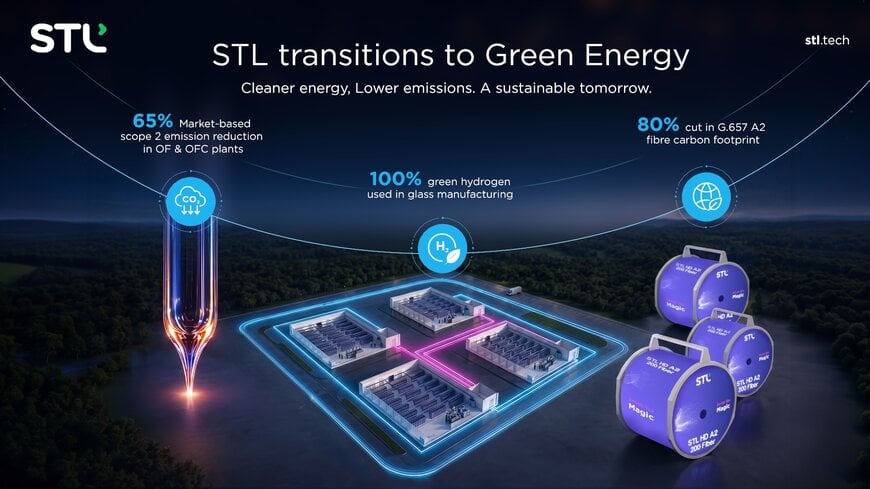
STL has announced significant progress in its decarbonization strategy by transitioning four of its manufacturing plants in Chhatrapati Sambhaji Nagar, Maharashtra, to 100% green power. Facilitated by the Maharashtra State Electricity Distribution Company Limited (MSEDCL), this shift from conventional fossil fuels to wind and solar energy is projected to reduce market-based Scope 2 emissions in the company's optical fibre facilities by approximately 65%. In addition to adopting renewable electricity, STL has integrated 100% green hydrogen into its glass manufacturing operations, effectively decarbonizing one of the most energy-intensive stages of optical fibre production.
These sustainability initiatives directly benefit STL's telecommunications and data center customers by significantly lowering the environmental impact of their digital infrastructure supply chains. Notably, the carbon footprint of the company's G.657.A2 optical fibre has dropped by 80%, from 4.7 kg to just 0.9 kg of CO₂e per fibre kilometer. To further reduce its Scope 3 operational emissions, STL has also updated its corporate mobility policy, offering enhanced limits and dedicated incentives for employees who choose to adopt electric and hybrid vehicles.
Additional Context
This section provides technological and market background not explicitly detailed in the original release.
The manufacturing of optical fibre preforms—the highly pure glass rods from which individual fibers are drawn—requires extremely high temperatures, typically achieved using specialized oxy-hydrogen torches. Historically, the hydrogen used in this process has been "grey hydrogen," derived from natural gas via steam methane reforming, a process that releases significant carbon dioxide. "Green hydrogen," in contrast, is produced through the electrolysis of water using renewable electricity, yielding zero carbon emissions. By combining green power with green hydrogen, optical manufacturers can tackle both Scope 2 (purchased electricity) and Scope 1 (direct manufacturing) emissions simultaneously. As global data center expansion accelerates to support AI workloads, hyperscalers and telecom operators are increasingly mandating eco-labeled products to meet their own aggressive net-zero supply chain targets.
Edited by Lekshman Ramdas, Induportals editor – adapted by AI.
www.stl.com
