
www.industry-asia-pacific.com
28
'26
Written on Modified on
IBASE Launches AA400-N Ultra-Compact Edge AI Computer
Powered by AMD Ryzen Embedded 8000 processors, the platform delivers 39 TOPS for industrial AI applications.
www.ibase.com.tw
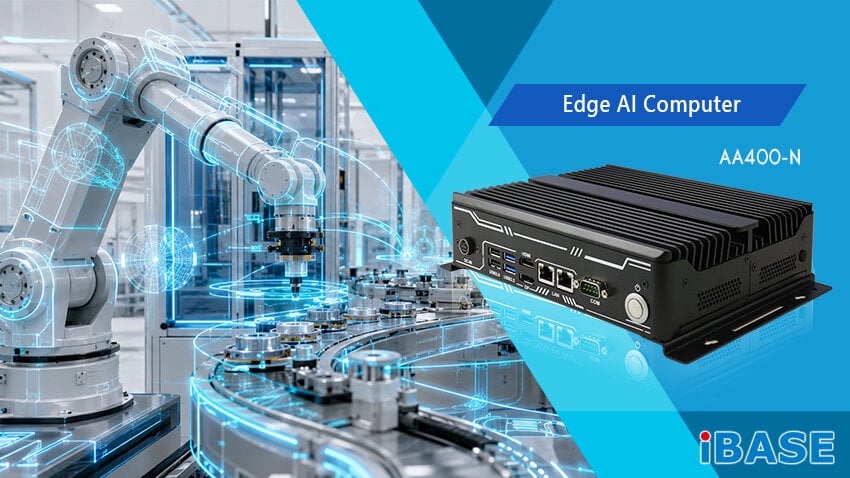
IBASE Technology Inc. has introduced the AA400-N, an ultra-compact, fanless edge AI computer engineered to provide system integrators with a flexible platform for next-generation intelligent applications. Powered by AMD Ryzen Embedded 8000 Series processors featuring up to eight cores and 16 threads, the device integrates CPU, GPU, and NPU capabilities to deliver a combined 39 TOPS of AI computing performance. Its highly integrated, space-efficient design allows integrators to develop responsive edge AI solutions for demanding environments, including machine vision, smart retail, and industrial automation.
Engineered for versatile expansion and connectivity, the AA400-N supports dual-channel DDR5-5600 memory up to 256GB and includes DisplayPort 2.1 and HDMI 2.1 outputs capable of 8K resolution. Measuring just 216 x 178 x 55 mm, the fanless unit offers both DIN-rail and wall-mount options for space-constrained installations. To accommodate diverse project requirements, the system features a 2.5GbE LAN port, multiple USB connections, and extensive M.2 expansion support for 5G/LTE connectivity, WiFi, Bluetooth, and PCIe Gen4 NVMe storage.
Additional Context
This section provides technological and market background not explicitly detailed in the original release.
The transition of artificial intelligence from cloud-based processing to the network edge requires robust hardware capable of executing complex inferencing models locally. The AMD Ryzen Embedded 8000 Series processors are significant because they are among the first to integrate an XDNA architecture-based Neural Processing Unit (NPU) directly on the chip alongside traditional x86 CPU and RDNA 3 GPU elements. This tri-architecture approach allows the NPU to handle sustained, low-power AI inferencing—providing up to 16 TOPS independently—which frees the CPU and GPU for real-time control, data aggregation, and high-resolution video decoding. In applications such as machine vision and automated quality inspection, this on-device processing minimizes latency, eliminates the high bandwidth costs associated with streaming raw video data to the cloud, and ensures that autonomous industrial systems can make critical routing and defect-detection decisions instantly, even during network interruptions.
Edited by Lekshman Ramdas, Induportals editor – adapted by AI.
www.ibase.com
