
www.industry-asia-pacific.com
21
'26
Written on Modified on
Hitachi High-Tech & Powrex Optimize Battery Cathode Coating with Physical AI
The collaboration combines coating expertise, process data and process informatics to identify optimal conditions for all-solid-state battery manufacturing.
www.hitachi.com
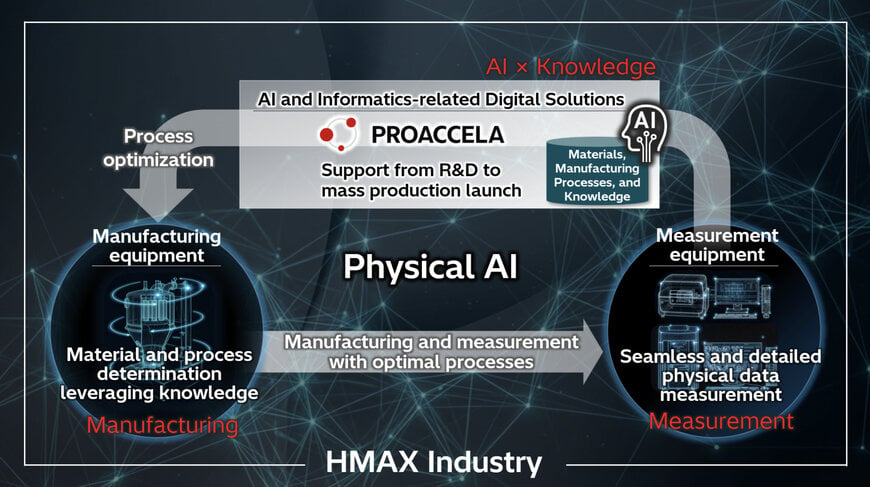
Hitachi High-Tech Corporation, utilizing its HMAX Industry physical AI platform, has partnered with Powrex Corporation to optimize the coating processes of cathode active materials for all-solid-state batteries. This cooperation implements a data-driven technical solution to standardize and accelerate process development within industrial battery manufacturing.
Addressing Degradation in Solid-State Batteries
All-solid-state batteries require specific manufacturing protocols to prevent resistive elements from forming at the interface between the cathode active material and the solid electrolyte. To mitigate energy output degradation, cathode particles must be coated with a lithium-conductive oxide film. Historically, achieving uniform coverage and precise film thickness required extensive trial and error, relying heavily on specialized engineering expertise. The cooperation between Hitachi High-Tech and Powrex addresses this operational complexity by combining advanced measurement technologies with industrial automation and process informatics.
Process Informatics and Analytical Integration
The technical solution integrates Powrex’s fluidized bed coating equipment data with Hitachi High-Tech’s measurement capabilities. Powrex manages the powder processing hardware and operational data generation, providing engineering expertise for highly complex particle shapes. Hitachi High-Tech applies its X-ray fluorescence analyzers (XRF) and scanning electron microscopes (SEM) to evaluate the coated samples without requiring complex pre-treatment. The resulting measurement data is then processed using PROACCELA, Hitachi’s process informatics platform, to compute and identify optimal processing parameters.
Quantitative Evaluation and Implementation
During the demonstration phase, samples processed under various manufacturing conditions were evaluated to establish a quantitative method for measuring coating thickness, uniformity, and interfacial characteristics. Operational equipment data and historical performance metrics were consolidated into a unified data table, forming a new digital infrastructure for the process. The AI algorithms analyzed this dataset to determine the causal relationships between processing parameters, material properties, and final battery performance, generating highly reproducible coating conditions.
Operational Benefits and Industrial Applications
Target applications for this technology include electric vehicle power systems and energy storage utilizing next-generation solid-state batteries. By transitioning from manual experimentation to a data-driven process, the system stabilizes manufacturing consistency and reduces the time required to scale from laboratory research to mass production facilities. The companies are working to commercialize these optimized coating protocols as part of the HMAX Industry suite, targeting the projected expansion of the solid-state battery market by 2030, with future adaptations planned for chemical and pharmaceutical powder processing.
Edited by Natania Lyngdoh, Induportals editor, assisted by AI.
www.hitachi.com
