
www.industry-asia-pacific.com
24
'26
Written on Modified on
Heavy-Lift eVTOLs Advance Low-Altitude Urban Aviation
AutoFlight collaborates with regional infrastructure and logistics partners to validate electric vertical take-off and landing operations within Hong Kong’s aviation regulatory framework.
www.autoflight.com
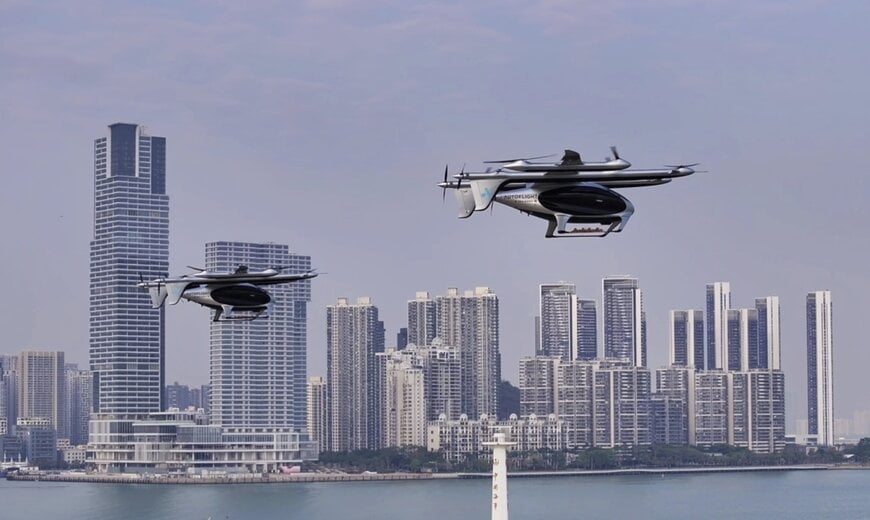
AutoFlight is partnering with China Travel Service Automobile Services Limited and AECOM Limited to test heavy-lift electric vertical take-off and landing (eVTOL) aircraft in urban airspace. This collaboration targets the development of a low-altitude logistics and transportation network across the Guangdong-Hong Kong-Macao Greater Bay Area.
Cooperative Framework and Operational Challenges
The deployment is part of "Regulatory Sandbox X," a low-altitude aviation initiative managed by the Transport and Logistics Bureau and the Civil Aviation Department of Hong Kong. Operating unmanned aerial vehicles in dense urban environments presents significant airspace integration, safety, and infrastructure challenges. To address these operational hurdles, the project relies on a cooperative framework. AutoFlight supplies the eVTOL hardware and technical flight data, while its partners handle the logistical planning, infrastructure integration, and regulatory alignment necessary to establish viable urban flight corridors.
Technical Solution and Responsibilities
The project utilizes AutoFlight’s heavy-lift eVTOL platforms, which rely on distributed electric propulsion systems designed for vertical ascent and transition to fixed-wing forward flight. Within the consortium, responsibilities are strictly divided. AutoFlight manages the aircraft's technical performance, system integrations, and hardware iterations. Meanwhile, AECOM and China Travel Service Automobile Services focus on route planning, flight-parameter calibration, and end-to-end flight validation. This division of labor allows the hardware to be tested against specific geographic parameters and safety standards, establishing a baseline for future unmanned traffic management systems.
Implementation and Scenario Validation
Testing takes place under the regulatory oversight of the Civil Aviation Department. The sandbox environment provides a controlled framework for scenario validation and compliant test flights without interfering with commercial civil aviation. During these implementation phases, the consortium will gather telemetry, battery performance metrics, and navigational data to iteratively upgrade the unmanned aircraft systems. The implementation aims to map out how these flight paths can be integrated safely into existing lower-airspace traffic corridors.
Target Applications and Operational Impact
The primary application areas include aerial logistics, high-efficiency cargo transport, and eventually passenger mobility. By utilizing heavy-lift eVTOLs, operators aim to bypass ground-level traffic congestion, resulting in faster transit times for payloads and reduced carbon emissions compared to traditional combustion-engine transport.
The validation flights will establish measurable operational standards for low-altitude aviation in Hong Kong. By calibrating flight parameters in a real-world urban environment, the project will generate the empirical safety and performance data required to scale up commercial operations.
Commenting on the technical trajectory of the project, Xie Jia, senior vice president of AutoFlight, stated that working with the Civil Aviation Department and industry partners allows the company to deepen its investment in core eVTOL technology and commercial deployment, providing the necessary data to help scale the Greater Bay Area’s low-altitude economy safely.
Edited by Aishwarya Mambet, Induportals Editor, with AI assistance.
www.autoflight.com
