
www.industry-asia-pacific.com
12
'26
Written on Modified on
Dürr Korea Supports KADAS Automated Vehicle Testing System Launch
x-road curve test stand enables advanced ADAS and autonomous driving evaluations within Korea’s pioneering vehicle inspection framework.
www.durr.com
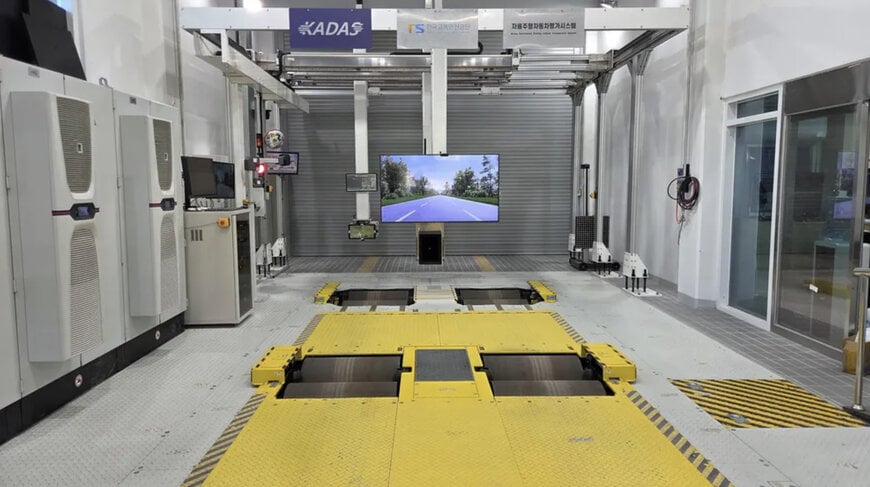
Dürr Korea is supporting the launch of the Korea Automated Driving Assessment System within a live technical inspection facility. This deployment establishes an integrated, non-restrained dynamic validation platform for land-based transport authorities, designed to optimize vehicle-in-the-loop diagnostic accuracy, regulatory compliance, and periodic technical inspections across urban data ecosystems.
The continuous standardization of active safety evaluation directly impacts the digital supply chain and the long-term operational integrity of passenger fleets. By expanding a uniform dynamic roll test architecture into institutional inspection centers, regulatory bodies can shorten test cycles and systematically verify physical system actuators without complex structural anchoring. This technological harmonization directly addresses the proliferation of high-level driver assistance networks as well as growing regional mandates for transparent, reproducible active safety benchmarking.
Mechanical Kinematics and Non-Restrained Cornering Simulation
The physical architecture of the x-road curve system utilizes a specialized multi-functional roll test configuration engineered to evaluate vehicular lateral and longitudinal dynamics simultaneously. The front axle assembly is equipped with steerable double roller sets that automatically adjust to match the wheel articulation angle of the test subject. By tracking the exact position and path of the front tires via laser measurement technology, the swiveling roller beds compensate for angular variations in real time, keeping the vehicle perfectly centered on the dynamometer at elevated operational velocities without mechanical tie-downs or chassis restraints.
Eliminating physical vehicle restraint systems prevents artificial stress distribution on the suspension and allows the onboard electronic stability control and active steering logic to operate under authentic loaded conditions. The system tests the complete physical and digital path spanning vehicle sensors, electronic control units, and mechanical brake or steering actuators during continuous turning maneuvers. This closed-loop configuration provides the precise physical reactions needed to evaluate complex advanced driver assistance systems including adaptive cruise control, lane departure warning, automatic emergency braking, and traffic sign recognition.
Sensor Over-the-Air Stimulation and Vehicle-in-the-Loop Integration
Validating perception systems requires an integrated environmental simulator that synchronizes digital roadway geometry with physical chassis reactions. The testing architecture links the multi-function roll stand with a specialized portal positioning system and an open-source simulation environment to generate over-the-air sensor stimulation. For machine vision camera arrays, high-resolution display screens project dynamic road markings, physical obstacles, and turning pathways directly into the lens sensor field of view, matching the speed and wheel angle of the physical vehicle on the rollers.
Simultaneously, radar target simulators generate localized radio-frequency delays and amplitude modifications to represent external traffic objects shifting distance and size in front of the vehicle. When the simulated radar objects or visual boundaries trigger defensive vehicle actions—such as a sudden emergency brake intervention or automated lane preservation steering—the x-road curve rollers apply a corresponding load simulation to mimic asphalt resistance. This complete vehicle-in-the-loop loop guarantees that the radar perception, camera logic, and mechanical braking responses behave uniformly without signaling data mismatches or triggering fault codes in the internal vehicle network.
Turnkey Deployment Timelines and Public Safety Frameworks
The Korea Transportation Safety Authority introduced the completed system setup at the Sejong Vehicle Inspection Center during a specialized preview convention attended by officials from the Ministry of Land, Infrastructure and Transport. The institutional deployment in Sejong City functions as an operational foundation for the commercial implementation of automated vehicle safety screening. The integration of active safety diagnostics into periodic technical inspections aligns with global initiatives targeting the complete elimination of traffic fatalities through rigorous infrastructure compliance.
To facilitate widespread deployment across standard municipal inspection bays, engineering teams are optimizing the multi-function roll stand, sensor portal, and real-time virtual simulation software into a single, highly compact turnkey vehicle-in-the-loop solution. This standardized, space-efficient testing package is scheduled for industrial introduction by the end of twelve months. The modular footprint is engineered to slide into existing structural inspection lanes, reducing the facility modification expenses and labor requirements typically associated with dynamic automated driving validation.
Additional Context:
This section details technical specifications and competitive benchmarking not included in the original product announcement
The launch of the Korea Automated Driving Assessment System featuring the Dürr x-road curve platform introduces a unique operational milestone, as active safety testing for automated features has traditionally been restricted to closed-course research proving grounds or end-of-line manufacturing facilities. Within the periodic technical inspection market, the system establishes a distinct technical alternative to conventional static calibration mats and traditional single-axis brake testing rollers provided by alternative inspection suppliers.
When evaluated against conventional end-of-line ADAS calibration configurations, such as the static target boards and stationary wheel-alignment bays utilized by service networks, the x-road curve introduces dynamic simulation capabilities. Standard calibration equipment can only check sensor positioning geometry and static radar alignment parameters while the vehicle is parked. By contrast, the vehicle-in-the-loop approach allows the car to accelerate, steer, and brake dynamically under real-world load conditions, ensuring that the actual electronic safety handshakes between sensor software and mechanical brake calipers remain fully operational long after the vehicle leaves the factory showroom.
In the international product landscape, the primary technological competition comes from specialized automotive test bench manufacturers like AVL List GmbH and Horiba, which produce highly advanced multi-axis vehicle-in-the-loop dynamometers for research and development applications. Systems like the AVL DRIVINGCUBE combine chassis dynamometers with over-the-air radar and camera stimulation to test autonomous driving software under laboratory settings. However, these research-grade systems typically require extensive vehicle anchoring, custom hub-connected drives, or large laboratory footprints that are cost-prohibitive and structurally incompatible with the high-throughput, rapid cycle times demanded by regional periodic technical inspection lanes.
The patented design of the x-road curve solves this operational constraint by utilizing laser-guided swiveling rollers instead of rigid tie-down straps, meaning a standard passenger vehicle can drive onto the test bench, undergo a multi-scenario lateral and longitudinal active safety examination, and exit the lane within a few minutes. By optimizing the hydraulic pump controls and matching the response latency of the open-source CARLA simulation interface to the physical roller resistance, the architecture achieves a highly repeatable testing benchmark for regional transportation authorities, validating advanced automated features under realistic cornering loads without risking physical collisions on public testing tracks.
Edited by Natania Lyngdoh, Induportals editor, assisted by AI.
www.durr.com
