
www.industry-asia-pacific.com
02
'26
Written on Modified on
GPU Architecture and Industrial Liquid Cooling Systems
PNY Technologies presents high-density graphics processing, memory, and storage platforms designed for data centers and artificial intelligence applications.
www.pny.com
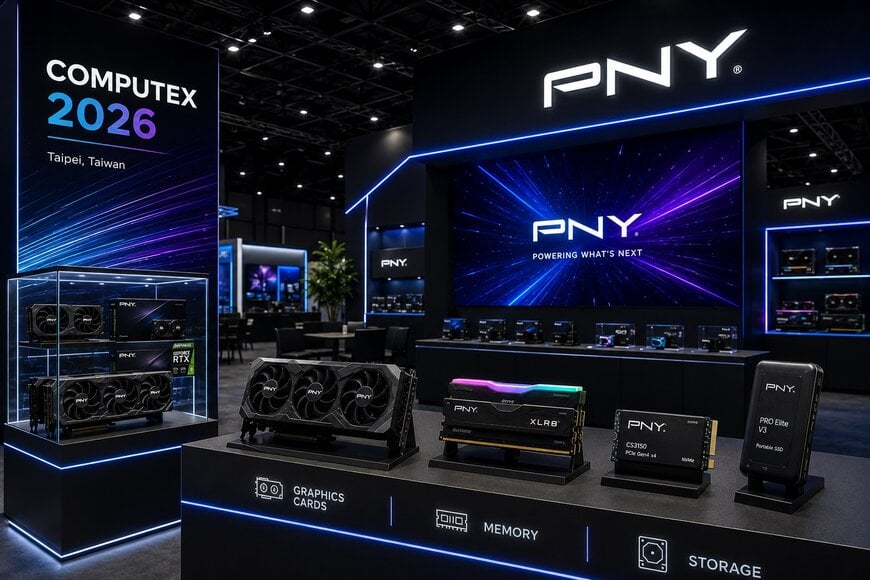
The integration of accelerated hardware in corporate environments and high-performance workstations requires advanced thermal management systems and scalable architectures. In this context, recent high-density graphic processing, memory, and storage solutions address the operational demands of digital creation, local artificial intelligence inference, and data center infrastructure.
Multi-GPU Systems and Advanced Thermal Management
Multi-GPU configurations require spatial and thermal optimization. The dual-slot, small-form-factor card series allows artificial intelligence developers and content creators to maximize computational density in standard workstations. To address thermal limits in high-performance hardware, the architecture based on the 32GB graphics processor with 5090-series specifications integrates a closed-loop liquid cooling system (AIO). Developed in conjunction with LYNK+, this design uses a full-coverage water block and modular technology that transfers thermal heat from the processor die, VRAM, and voltage regulators, ensuring stability under sustained operational loads.
Storage and Memory for Data Centers
Massive data processing demands high-bandwidth, low-latency memory infrastructures. The deployment of DDR5 memory modules in RDIMM format, alongside enterprise-grade solid-state drives (SSDs), provides the technical foundation for virtualization environments and artificial intelligence workloads. These storage architectures prevent data transfer bottlenecks between non-volatile storage and the main system memory.
Local AI Inference and Graphics Processing Applications
Current computational platforms enable the execution of large-scale algorithms without relying on network latencies. The implementation of hardware-assisted multi-frame generation technologies improves fluidity in complex graphical simulations and real-time rendered environments. In the field of AI-generated video, GPU acceleration allows for workflows such as converting static images into dynamic sequences processed locally. Additionally, the use of open-source artificial intelligence assistants running on tensor and unified compute cores ensures data privacy and reduces response times in corporate task automation.
Virtualization and Corporate AI Agents
In corporate infrastructures, physical GPU partitioning technology allows a single Blackwell-architecture-based unit to be divided into multiple isolated hardware instances. This facilitates the simultaneous and independent execution of various artificial intelligence agents across Windows and Linux operating environments, optimizing resource usage and ensuring the thermal and logical isolation of processes. Furthermore, systems designed for inference process advanced linguistic models locally, increasing performance in logical reasoning tasks applied to business operations. These compute capabilities also facilitate digital twin simulation, replicating industrial processes and factories with physical precision.
Presentation at Industry Events
The hardware architecture, liquid cooling systems, and local inference implementations are exhibited at the Computex 2026 trade fair, held from June 2 to 5 at the Nangang Exhibition Center in Taipei.
Additional Context: This section details technical specifications and benchmarks not included in the original product announcement.
In the current high-performance computing components market, the adoption of modular liquid cooling (AIO) for graphics processors consuming over 450 watts has been consolidated as an operational standard to avoid thermal throttling. Comparable industry systems use high-density radiators to dissipate heat from monolithic cores and their associated GDDR7 memory modules, maintaining stable clock frequencies under continuous machine learning workloads. Likewise, hardware virtualization through silicon-level segmentation technologies competes directly with software-based hypervisors, offering the mechanical advantage of isolating memory faults and allocating deterministic processing bandwidth to each virtual machine or neural network container.
Edited by an industrial journalist, Lekshman Ramdas, with AI assistance
www.pny.com
