
www.industry-asia-pacific.com
29
'26
Written on Modified on
Renewable Energy Recovery System for Pulp Mills
ANDRITZ will supply chemical recovery and energy generation technologies to support circular production and biomass-based power generation in Thailand.
www.andritz.com
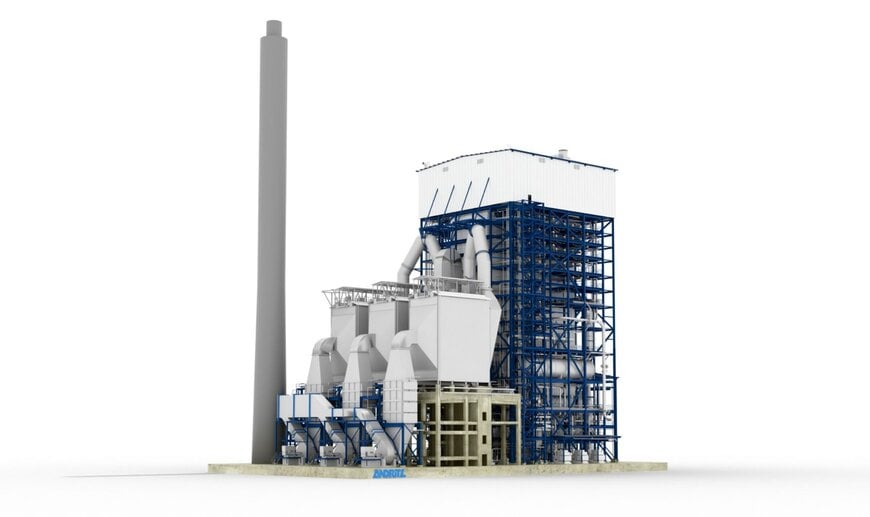
National Power Supply Public Company Limited (NPS), part of Double A Group, has selected ANDRITZ to provide a recovery boiler, black liquor evaporation plant, and ash treatment system for a new bioenergy facility at a pulp and paper mill in Tha-Toom, Thailand. The project is designed to recover process chemicals while generating renewable electricity from pulp production residues.
The installation supports both energy production and resource recovery, addressing two critical requirements in modern pulp manufacturing: reducing dependence on external energy sources and improving material circularity within mill operations.
Bioenergy Project Integrates Chemical Recovery and Power Generation
The project will be implemented at Double A Group's pulp and paper mill and is intended to convert black liquor, a by-product generated during the chemical pulping process, into renewable energy and reusable process chemicals.
Black liquor contains dissolved lignin, organic compounds, and inorganic pulping chemicals. Recovery systems enable mills to burn this by-product to generate steam while simultaneously recovering chemicals required for subsequent pulp production cycles. This approach has become a standard component of modern kraft pulp mills because it improves energy efficiency and reduces raw material consumption.
The contract value is reported in the high double-digit million euro range and was included in ANDRITZ's order intake for the first quarter of 2026. Commissioning of the recovery boiler and evaporation plant is scheduled for the second quarter of 2028.
Recovery Boiler Converts Black Liquor into Renewable Power
The centerpiece of the project is a recovery boiler designed to process 3,300 metric tonnes of black liquor dry solids per day.
Recovery boilers perform two key functions within pulp production facilities. First, they generate high-pressure steam that can be used to produce electricity for mill operations and, in some cases, export surplus power to the public grid. Second, they recover valuable pulping chemicals from combustion residues, allowing these materials to be returned to the production process.
The ANDRITZ system incorporates an electrostatic precipitator for flue-gas cleaning. Electrostatic precipitators remove particulate matter from exhaust gases by electrically charging particles and collecting them on dedicated surfaces, helping facilities meet emissions requirements while improving environmental performance.
The boiler package also includes automation and digitalization technologies intended to optimize combustion efficiency, process stability, and operating availability.
High-Capacity Black Liquor Evaporation System
The project includes a black liquor evaporation plant with a processing capacity of 727 tonnes per hour.
Evaporation is a critical stage in chemical recovery because black liquor must be concentrated before it can be efficiently combusted in a recovery boiler. Increasing solids concentration improves combustion performance and energy recovery while reducing the amount of water entering the boiler.
According to ANDRITZ, the evaporation plant utilizes lamella heating surfaces designed for easier cleaning and high operational availability. The system also produces condensate suitable for reuse in other mill processes, contributing to improved water utilization and supporting broader sustainability objectives.
Integrated automation and digital monitoring functions are intended to support process control and maintenance planning throughout plant operations.
Ash Re-Crystallization Supports Chemical Circularity
A further component of the installation is an integrated ash re-crystallization (ARC) system capable of processing 220 tonnes of ash per day from the recovery boiler's electrostatic precipitator.
The purpose of the ARC system is to reduce chloride and potassium concentrations within the recovery cycle. These elements can accumulate over time and negatively affect boiler performance, corrosion rates, and process efficiency.
The technology recovers sodium and sulfate compounds from ash streams and returns them to the pulping process, reducing chemical losses and improving resource efficiency. Such systems have become increasingly important in large-scale pulp mills seeking to maximize chemical recovery rates while maintaining stable recovery boiler operation.
ANDRITZ reports that similar ARC systems have already been deployed at multiple pulp production facilities across Asia.
Renewable Energy and Circular Manufacturing Benefits
The installation illustrates how modern pulp mills are evolving into integrated bioenergy and resource-recovery facilities. By converting process residues into electricity and recovering chemicals for reuse, mills can reduce waste streams while improving overall energy efficiency.
For operators such as NPS and Double A Group, this approach supports renewable power generation alongside circular manufacturing practices. The recovered steam can be used for electricity generation and process heating, while recovered chemicals reduce dependence on externally sourced inputs.
Such projects are becoming increasingly relevant as pulp producers seek to improve energy self-sufficiency, reduce emissions, and strengthen sustainability performance across the digital supply chain.
Automation and Digital Process Optimization
The recovery boiler, evaporation plant, and ARC system will all incorporate automation and digitalization technologies designed to improve operational visibility and process performance.
In modern pulp production facilities, digital process monitoring enables operators to track combustion efficiency, chemical recovery rates, equipment health, and emissions performance in real time. These capabilities can contribute to higher plant availability and more consistent production outcomes.
As pulp mills become more integrated energy-generation assets, digital process management is increasingly viewed as an important factor in maximizing both production efficiency and renewable energy output.
Edited by Aishwarya Mambet, Induportals Editor, with AI assistance.
www.andritz.com
