
www.industry-asia-pacific.com
07
'26
Written on Modified on
Liquid Hydrogen Storage Project Targets Large-Scale Infrastructure
Hyundai E&C joins a national R&D program to develop cryogenic storage tanks and handling systems, supporting the expansion of hydrogen infrastructure and the future hydrogen economy.
www.hyundaimotorgroup.com
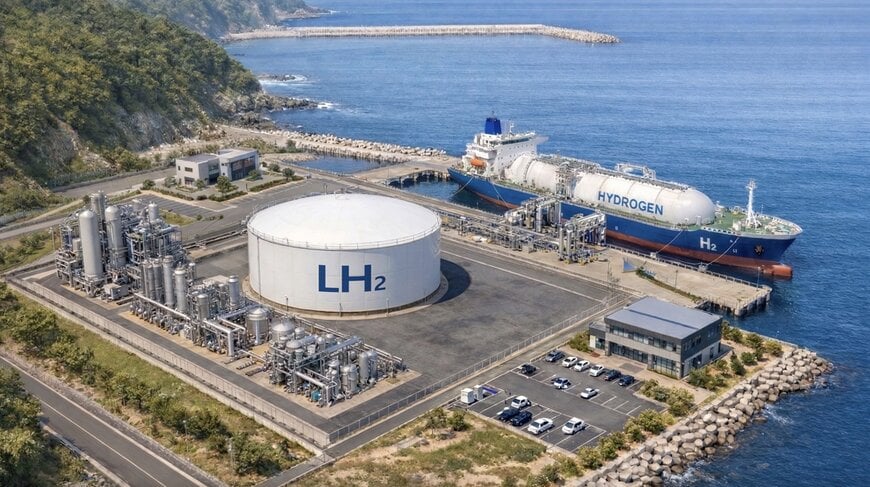
Hyundai E&C has been selected for a national research and development project to design and demonstrate liquid hydrogen storage infrastructure. The initiative, supported by the Korea Agency for Infrastructure Technology Advancement under the Ministry of Land, Infrastructure and Transport, focuses on developing storage, transfer, and handling technologies for large-scale hydrogen deployment.
Cryogenic storage for hydrogen infrastructure
Liquid hydrogen is produced by cooling gaseous hydrogen to approximately −253°C, significantly increasing its energy density for storage and transport. Maintaining this state requires advanced cryogenic systems with high-performance insulation and precise thermal management.
The project targets the development of storage tanks capable of handling these conditions while minimizing energy losses and ensuring operational safety.
Scale-up toward industrial storage capacity
A key objective is the development of flat-bottom cylindrical storage tanks, a design commonly used in liquefied natural gas (LNG) infrastructure. Applying this concept to liquid hydrogen represents a technological adaptation to support larger storage volumes.
Planned capacities include:
- Demonstration-scale tanks of approximately 200 m³
- Future commercial designs targeting 4,000 m³ and 50,000 m³
These capacities are intended to support receiving terminals and large-scale hydrogen distribution networks.
Engineering challenges and system design
The development program addresses multiple technical areas required for safe and efficient storage:
Engineering challenges and system design
The development program addresses multiple technical areas required for safe and efficient storage:
- Structural design for cryogenic conditions
- Thermal insulation systems to reduce heat ingress
- Fluid dynamics and heat transfer analysis
- Material performance under extreme temperatures
Reducing boil-off gas—hydrogen that evaporates due to heat leakage—is a central design requirement, as it directly impacts efficiency and safety.
Collaborative development and standardization
The project involves collaboration with 14 partners from industry, academia, and research institutions, including the Korea Gas Corporation and related technical organizations. The consortium will cover the full lifecycle from design and construction to demonstration and operation.
In parallel, the initiative includes the development of standardized material property databases and engineering design guidelines, supporting future industrial deployment.
Edited by Romila DSilva, Induportals Editor, with AI assistance.
Collaborative development and standardization
The project involves collaboration with 14 partners from industry, academia, and research institutions, including the Korea Gas Corporation and related technical organizations. The consortium will cover the full lifecycle from design and construction to demonstration and operation.
In parallel, the initiative includes the development of standardized material property databases and engineering design guidelines, supporting future industrial deployment.
Edited by Romila DSilva, Induportals Editor, with AI assistance.
