
www.industry-asia-pacific.com
24
'26
Written on Modified on
Waste Oil Improves Blasting Performance
MNK BME integrates recycled transmission oil to reduce costs and emissions while maintaining stable emulsion explosive performance in Indonesian mining operations.
www.bme.de
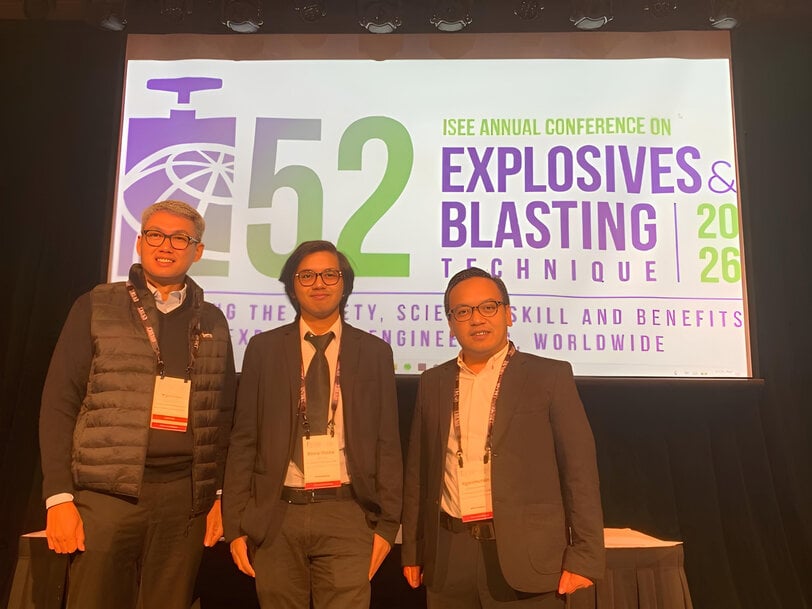
(left to right) Agusman, Country Manager, Indonesia BME; Khiva Tassno, Lab Technician, MNK BME; Ngisomuddin, Operations General Manager, MBK BME
MNK BME, a joint venture between PT Multi Nitrotama Kimia and BME Indonesia, has implemented the reuse of used transmission oil as a fuel component in emulsion explosives (EE) for mining applications. The approach targets cost reduction, waste minimisation, and improved environmental performance without compromising blasting efficiency.
Context: Managing hazardous waste in mining operations
Mining operations generate significant volumes of used oils, including transmission oil, which require controlled disposal due to environmental risks. Conventional disposal methods—incineration or landfilling—contribute to greenhouse gas emissions and operational costs.
MNK BME sought to address these challenges by integrating recycled oil into EE formulations. The objective was to reduce reliance on virgin hydrocarbons such as refined biodiesel while maintaining detonation performance and operational reliability in large-scale blasting.
Technical approach: Reformulating emulsion explosives
The project involved substituting part of the fuel phase in water-in-oil emulsion explosives with used transmission oil. Laboratory work focused on analysing hydrocarbon composition, impurities, and compatibility with ammonium nitrate oxidiser systems.
Transmission oil presents specific challenges due to its additive content and polarity, which can affect emulsion stability. Contaminants such as water, metals, and oxidation by-products were identified as potential causes of crystallisation or phase separation, leading to reduced velocity of detonation (VOD) or incomplete energy release.
To address these risks, MNK BME developed and tested multiple formulations under controlled conditions. Six base formulations were evaluated across varying concentrations of used transmission oil blended with used engine oil.
Validation: Stability and performance testing
Laboratory stress testing confirmed that all tested formulations met stability requirements under defined conditions. Gassing tests demonstrated that the emulsions could be reliably sensitised and initiated.
Crystal growth analysis showed increasing crystallisation tendencies at higher concentrations of transmission oil, indicating the need for controlled dosing and strict quality specifications.
The importance of quality control was reinforced by a prior off-spec incident, where unsuitable used oil reduced VOD from 5,123 m/s to 4,293 m/s, affecting blast performance and production efficiency.
Field deployment: Operational results in Indonesian mines
Field trials were conducted in April 2025 across 12 benches in an Indonesian mine, using a 70:30 blend of used oil in EE formulations. The trials involved collaboration between MNK BME engineers and mining specialists from PT Saptaindra Sejati and Adaro Indonesia.
Blasting performance was evaluated using standard parameters, including VOD, fragmentation, and digging time. Results showed:
MNK BME, a joint venture between PT Multi Nitrotama Kimia and BME Indonesia, has implemented the reuse of used transmission oil as a fuel component in emulsion explosives (EE) for mining applications. The approach targets cost reduction, waste minimisation, and improved environmental performance without compromising blasting efficiency.
Context: Managing hazardous waste in mining operations
Mining operations generate significant volumes of used oils, including transmission oil, which require controlled disposal due to environmental risks. Conventional disposal methods—incineration or landfilling—contribute to greenhouse gas emissions and operational costs.
MNK BME sought to address these challenges by integrating recycled oil into EE formulations. The objective was to reduce reliance on virgin hydrocarbons such as refined biodiesel while maintaining detonation performance and operational reliability in large-scale blasting.
Technical approach: Reformulating emulsion explosives
The project involved substituting part of the fuel phase in water-in-oil emulsion explosives with used transmission oil. Laboratory work focused on analysing hydrocarbon composition, impurities, and compatibility with ammonium nitrate oxidiser systems.
Transmission oil presents specific challenges due to its additive content and polarity, which can affect emulsion stability. Contaminants such as water, metals, and oxidation by-products were identified as potential causes of crystallisation or phase separation, leading to reduced velocity of detonation (VOD) or incomplete energy release.
To address these risks, MNK BME developed and tested multiple formulations under controlled conditions. Six base formulations were evaluated across varying concentrations of used transmission oil blended with used engine oil.
Validation: Stability and performance testing
Laboratory stress testing confirmed that all tested formulations met stability requirements under defined conditions. Gassing tests demonstrated that the emulsions could be reliably sensitised and initiated.
Crystal growth analysis showed increasing crystallisation tendencies at higher concentrations of transmission oil, indicating the need for controlled dosing and strict quality specifications.
The importance of quality control was reinforced by a prior off-spec incident, where unsuitable used oil reduced VOD from 5,123 m/s to 4,293 m/s, affecting blast performance and production efficiency.
Field deployment: Operational results in Indonesian mines
Field trials were conducted in April 2025 across 12 benches in an Indonesian mine, using a 70:30 blend of used oil in EE formulations. The trials involved collaboration between MNK BME engineers and mining specialists from PT Saptaindra Sejati and Adaro Indonesia.
Blasting performance was evaluated using standard parameters, including VOD, fragmentation, and digging time. Results showed:
- Average VOD of 5,263 m/s, indicating stable detonation
- Average fragmentation of 660 mm, supporting efficient downstream processing
- Digging times ranging from 9.02 to 11.54 seconds, averaging approximately 10.4 seconds
Visual observations confirmed effective rock displacement and energy distribution.
Impact: Cost savings and emissions reduction
The integration of recycled transmission oil reduced dependence on refined fuels, delivering approximately 65% savings in the diesel-related component of explosive production costs.
From an environmental perspective, the approach is projected to reduce CO₂ emissions by around 66,000 kg per month, equivalent to a 56.7% decrease associated with explosive production.
Conclusion: Industrial scalability and sustainability
The project demonstrates that recycled industrial waste streams can be integrated into high-performance blasting systems when supported by rigorous testing and quality control. MNK BME presented these findings at the International Society of Explosives Engineers 52nd Annual Conference in Reno, Nevada, highlighting the technical feasibility of combining cost efficiency with reduced environmental impact.
Edited by an industrial journalist, Lekshman Ramdas, with AI assistance.
www.bme.com
Impact: Cost savings and emissions reduction
The integration of recycled transmission oil reduced dependence on refined fuels, delivering approximately 65% savings in the diesel-related component of explosive production costs.
From an environmental perspective, the approach is projected to reduce CO₂ emissions by around 66,000 kg per month, equivalent to a 56.7% decrease associated with explosive production.
Conclusion: Industrial scalability and sustainability
The project demonstrates that recycled industrial waste streams can be integrated into high-performance blasting systems when supported by rigorous testing and quality control. MNK BME presented these findings at the International Society of Explosives Engineers 52nd Annual Conference in Reno, Nevada, highlighting the technical feasibility of combining cost efficiency with reduced environmental impact.
Edited by an industrial journalist, Lekshman Ramdas, with AI assistance.
www.bme.com
