
www.industry-asia-pacific.com
22
'26
Written on Modified on
Wind Power Integration for Pilbara Mining Operations
Fortescue and Envision Energy collaborate on a renewable energy system to supply 133 MW of wind generation for decarbonising industrial operations in Western Australia’s Pilbara.
www.fortescue.com
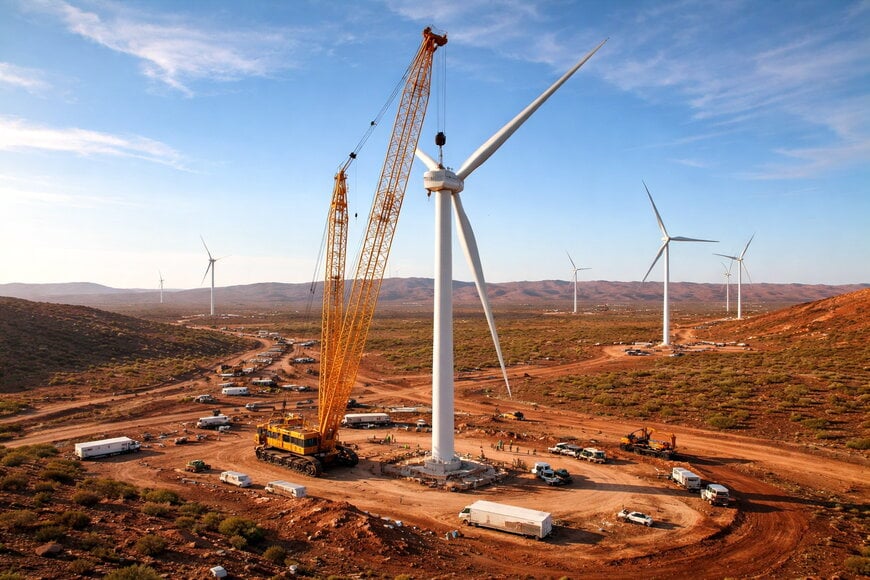
Construction has commenced on the Nullagine Wind Project in Western Australia’s Pilbara, marking the first operational wind installation by Fortescue that is specifically designed to support renewable power generation for heavy mining operations. The project represents a pivotal development in Fortescue’s broader renewable strategy and illustrates differentiation in wind deployment for industrial decarbonisation.
A Strategic Renewable Energy Deployment for Mining Operations
The Nullagine Wind Project will deliver 133 megawatts (MW) of generation capacity through the installation of 17 wind turbines. The turbines are supplied by Envision Energy and will be erected using self-erecting tower technology acquired by Fortescue through its full ownership of Spanish wind technology company Nabrawind. This tower system allows for greater hub heights—188 metres in this case—than conventional approaches, enabling access to higher-speed wind regimes and higher overall energy yield in the Pilbara’s low-wind environment. Such design considerations support continuous generation across variable wind profiles and are engineered to withstand extreme weather conditions, including cyclones.
This project differs from standard utility-scale wind farms in its integration of self-lifting technology, which simplifies logistics and reduces reliance on heavy-lift crane operations in remote locations, and by extending turbine height to capture stronger winds. These attributes are significant in the context of industrial renewable energy, where reliability and resilience directly impact mining operations. By combining advanced turbine performance with structural innovation, Fortescue aims to achieve cost-efficient power generation in a region historically dominated by fossil fuel reliance.
Integration with Wider Renewable Infrastructure
The wind project is part of Fortescue’s multi-gigawatt renewable energy roadmap, which includes large-scale solar photovoltaics and battery storage systems feeding into its internal energy network, Pilbara Energy Connect. The integration of daytime solar with seasonal and nighttime wind generation contributes to a more balanced and dependable renewable supply capable of replacing diesel and gas generation across haul trucks, processing plants, rail systems and other mining infrastructure. Complementary solar capacity is under construction at the nearby Cloudbreak Solar Farm, involving over 300 000 solar panels, and large-scale batteries have been deployed at North Star Junction to stabilize supply.
By 2030, Fortescue plans to deploy between 2 and 3 gigawatts of combined renewable energy and battery storage across the Pilbara subject to regulatory approvals, positioning the company to reduce operational emissions without relying on carbon offsets.
Setting Benchmarks in Industrial Wind Deployment
The Nullagine project introduces technological benchmarks for onshore wind in Australia through its use of tallest-of-type towers and turbines engineered for low-wind conditions. The integration of Nabrawind’s tower system with Envision’s turbine platform represents one of the first large-scale applications of this configuration in the country and establishes a model for industrial wind installations in remote, harsh environments. A prototype turbine of this design has been installed at an Envision testing facility and is planned to be relocated to the Pilbara mid-2026 for commissioning.
In the broader market context, Fortescue’s approach reflects a deliberate emphasis on combining generation diversity (wind, solar, storage) with structural and logistical innovations to achieve reliable, low-cost and resilient renewable power for mining applications. This strategy differentiates it from traditional utility wind projects by prioritising industrial energy requirements, extreme condition tolerance and integration with onsite electrification initiatives.
www.fortescue.com
