
www.industry-asia-pacific.com
10
'26
Written on Modified on
Ballard Power and Kolon Industries Expand Their Fuel Cell Technology Partnership
Building on a long-term alliance, the companies will deepen collaboration on advanced moisture control devices and the global hydrogen value chain.
www.ballard.com
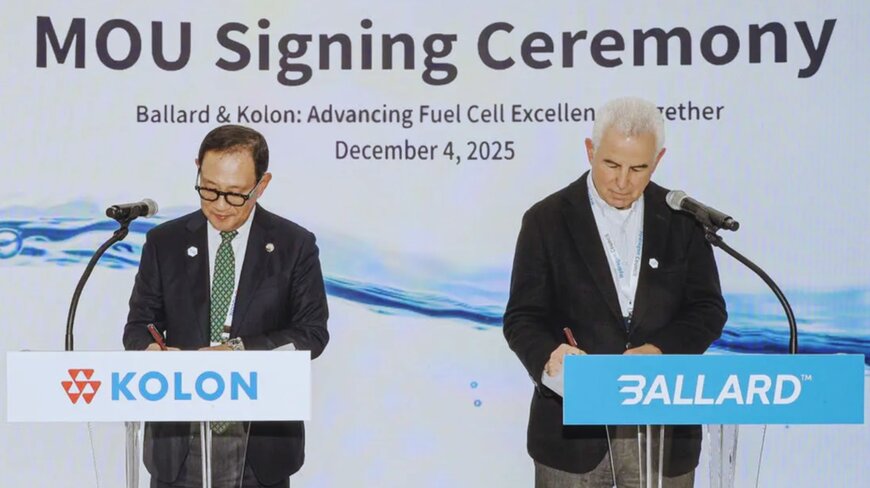
Ballard Power Systems and South Korea’s Kolon Industries have formalised a strategic agreement designed to strengthen their positions in the hydrogen fuel cell market by deepening collaboration on core technologies, stabilising critical components supply, and accelerating joint development efforts. This agreement expands an existing long-term partnership and aims to improve competitiveness relative to other players in the fuel cell supply chain.
Expanded Collaboration Between Established Fuel Cell Partners
In December 2025, Ballard Power Systems and Kolon Industries signed a Memorandum of Understanding (MoU) at the World Hydrogen Expo in Seoul, South Korea, signalling a commitment to enhanced strategic cooperation. The partnership builds on a supply relationship that has existed since 2018, under which Kolon provided moisture control devices (MCDs) for Ballard’s fuel cell systems, an essential component for managing humidity in proton exchange membrane (PEM) fuel cell operation.
Ballard, a Canadian company founded in 1979, is recognised globally for its advanced hydrogen fuel cell systems used in heavy-duty mobility and stationary power applications. Kolon Industries brings decades of expertise in materials science and manufacturing, holding a leading share of the global market for MCDs and membrane components.
Focus on Performance, Supply Chain Resilience, and Cost Competitiveness
The expanded agreement emphasises three strategic priorities. First, the partners intend to develop a more resilient and stable supply chain for critical components such as humidifiers and moisture control devices, addressing a key industry challenge where supply bottlenecks can disrupt production and deployment timelines. Second, the collaboration will accelerate joint research and development initiatives to improve the performance and integration of these components within Ballard’s fuel cell systems. Finally, the approach aims to reduce engineering and validation costs through better technical alignment and manufacturing scalability, strengthening Ballard’s cost-reduction roadmap and competitive positioning in the broader hydrogen technology market.
Implications for Global Hydrogen Applications
While the agreement does not immediately introduce new products, it establishes a framework for ongoing cooperation that supports Ballard’s global deployments in mobility and energy storage. By leveraging Kolon’s scalable manufacturing capabilities and Ballard’s fuel cell expertise, the partnership aims to deliver more predictable performance and cost efficiencies that could differentiate their combined offerings against competitors who rely on more fragmented supplier networks.
This strategic alignment reflects broader industry trends where fuel cell developers and component specialists collaborate to address market challenges such as supply security, cost reduction, and technological performance — factors critical to scaling hydrogen solutions across commercial vehicles, rail, marine, and stationary power sectors.
www.ballard.com
