
www.industry-asia-pacific.com
10
'26
Written on Modified on
Grid-Scale Solar Accelerates in New Zealand’s Power System
Rising utility-scale solar capacity reshapes generation mix, forecasting requirements, and wholesale market dynamics.
www.ea.govt.nz
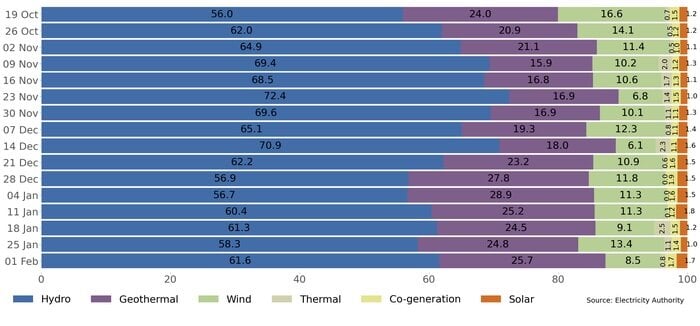
Weekly generation composition 19 October 2025 - 1 February 2026
New Zealand’s electricity system is undergoing a rapid expansion of grid-connected solar generation, with utility-scale solar increasingly influencing generation profiles, operational planning, and wholesale market outcomes. Since 2023, grid-scale solar capacity has grown by 247 MW, and its contribution to national electricity supply is now regularly visible in weekly generation data.
From mid-October 2025, grid-connected solar has consistently supplied 1–2% of total electricity demand, at times exceeding the contribution from thermal generation, which has remained below 1% for most weeks during this period. As a result, total renewable generation has exceeded 97% for extended periods, highlighting the system-wide impact of new solar assets.
Solar Performance Rivals Wind and Thermal Generation
Although wind generation remains the largest source of intermittent renewable capacity with 1,257 MW installed, solar output has, on occasion, matched or surpassed wind generation on a half-hourly basis. This occurred during 27–28 January 2026, when favourable solar conditions coincided with lower wind output.
Solar generation also reached a new operational milestone on 30 January 2026, achieving a half-hourly maximum output of 210 MW at 3:30 pm, reflecting the growing scale and performance of installed photovoltaic assets.
Installed Solar Capacity Set to Triple by 2028
The grid-connected solar pipeline continues to expand rapidly. Projects currently under construction and scheduled for commissioning in 2026–2027 represent an additional 783 MW of capacity, which would bring New Zealand’s total grid-scale solar capacity to approximately 1,031 MW.
This expansion is expected to significantly increase periods of very high renewable generation. During these intervals, dispatchable resources such as hydro storage, gas, and coal can be conserved and deployed during low renewable output or peak demand periods, improving overall system flexibility.
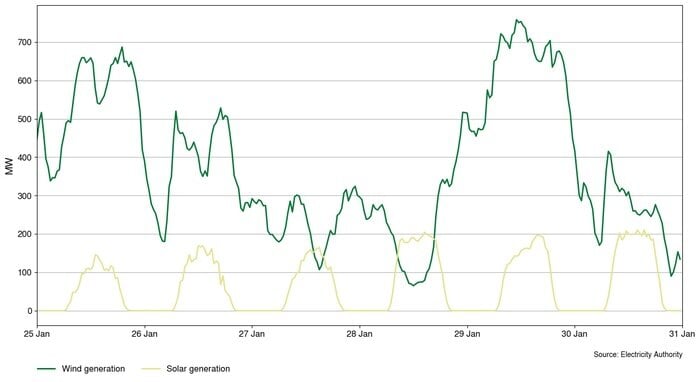
Half hourly average wind and solar generation 25-31 January 2026
Market Impacts: Renewable Generation and Price Suppression
Higher renewable penetration has had a direct impact on wholesale electricity pricing. Since mid-October 2025, when renewable generation consistently exceeded 97%, the average wholesale electricity price has fallen to approximately $2.30/MWh. This contrasts sharply with the 2025 annual average wholesale price of $150/MWh, underscoring the price-suppressing effect of high renewable availability.
Forecasting and Investment Visibility Improvements
As intermittent generation increases, accurate forecasting has become a critical system requirement. Electricity Authority Te Mana Hiko has implemented several initiatives to support system stability and informed investment decisions.
In 2025, the Authority introduced a hybrid forecasting framework and awarded DNV Services a contract to deliver centralized wind and solar generation forecasts. Since August 2025, centralized forecasting has been mandatory for wind and solar generators unless explicitly exempted. Forecast accuracy has improved under this model, reducing unexpected generation shortfalls and supporting more predictable market outcomes.
In parallel, the Authority is expanding transparency around the generation investment pipeline. A recent consultation proposed collecting and publishing data on significant generation and load connections to distribution networks. Improved visibility of future supply and demand is intended to support timely infrastructure investment, enhance security of supply, and inform long-term policy and market planning. A regulatory decision is expected in the coming months.
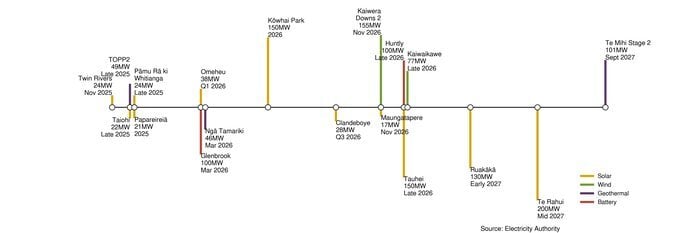
Timeline of projects under construction, February 2026
Outlook
With grid-connected solar capacity set to triple by 2028, New Zealand’s electricity system is entering a phase where solar generation becomes a structurally significant contributor. Continued investment in forecasting technology, market transparency, and system flexibility will be essential to fully realise the benefits of high renewable penetration while maintaining reliability and security of supply.
www.ea.govt
New Zealand’s electricity system is undergoing a rapid expansion of grid-connected solar generation, with utility-scale solar increasingly influencing generation profiles, operational planning, and wholesale market outcomes. Since 2023, grid-scale solar capacity has grown by 247 MW, and its contribution to national electricity supply is now regularly visible in weekly generation data.
From mid-October 2025, grid-connected solar has consistently supplied 1–2% of total electricity demand, at times exceeding the contribution from thermal generation, which has remained below 1% for most weeks during this period. As a result, total renewable generation has exceeded 97% for extended periods, highlighting the system-wide impact of new solar assets.
Solar Performance Rivals Wind and Thermal Generation
Although wind generation remains the largest source of intermittent renewable capacity with 1,257 MW installed, solar output has, on occasion, matched or surpassed wind generation on a half-hourly basis. This occurred during 27–28 January 2026, when favourable solar conditions coincided with lower wind output.
Solar generation also reached a new operational milestone on 30 January 2026, achieving a half-hourly maximum output of 210 MW at 3:30 pm, reflecting the growing scale and performance of installed photovoltaic assets.
Installed Solar Capacity Set to Triple by 2028
The grid-connected solar pipeline continues to expand rapidly. Projects currently under construction and scheduled for commissioning in 2026–2027 represent an additional 783 MW of capacity, which would bring New Zealand’s total grid-scale solar capacity to approximately 1,031 MW.
This expansion is expected to significantly increase periods of very high renewable generation. During these intervals, dispatchable resources such as hydro storage, gas, and coal can be conserved and deployed during low renewable output or peak demand periods, improving overall system flexibility.
Half hourly average wind and solar generation 25-31 January 2026
Market Impacts: Renewable Generation and Price Suppression
Higher renewable penetration has had a direct impact on wholesale electricity pricing. Since mid-October 2025, when renewable generation consistently exceeded 97%, the average wholesale electricity price has fallen to approximately $2.30/MWh. This contrasts sharply with the 2025 annual average wholesale price of $150/MWh, underscoring the price-suppressing effect of high renewable availability.
Forecasting and Investment Visibility Improvements
As intermittent generation increases, accurate forecasting has become a critical system requirement. Electricity Authority Te Mana Hiko has implemented several initiatives to support system stability and informed investment decisions.
In 2025, the Authority introduced a hybrid forecasting framework and awarded DNV Services a contract to deliver centralized wind and solar generation forecasts. Since August 2025, centralized forecasting has been mandatory for wind and solar generators unless explicitly exempted. Forecast accuracy has improved under this model, reducing unexpected generation shortfalls and supporting more predictable market outcomes.
In parallel, the Authority is expanding transparency around the generation investment pipeline. A recent consultation proposed collecting and publishing data on significant generation and load connections to distribution networks. Improved visibility of future supply and demand is intended to support timely infrastructure investment, enhance security of supply, and inform long-term policy and market planning. A regulatory decision is expected in the coming months.
Timeline of projects under construction, February 2026
Outlook
With grid-connected solar capacity set to triple by 2028, New Zealand’s electricity system is entering a phase where solar generation becomes a structurally significant contributor. Continued investment in forecasting technology, market transparency, and system flexibility will be essential to fully realise the benefits of high renewable penetration while maintaining reliability and security of supply.
www.ea.govt
