
www.industry-asia-pacific.com
07
'26
Written on Modified on
Advanced Process Control Optimizes Cement Grinding and Kiln Operations
Tokuyama deployed advanced process control technologies across multiple grinding mills and kiln systems to reduce specific power consumption and improve production throughput.
global.abb
Application Area: Industrial Process Optimization, Autonomous Plant Operations
Industry Sector: Cement Manufacturing, Heavy Building Materials
Cement manufacturing requires continuous thermal and mechanical processing, where raw materials undergo high-temperature reactions in kilns before being ground into fine powder across finish mills. At the Nanyo Plant in Japan, one of the country's largest cement manufacturing facilities, managing operational variability across these energy-intensive assets posed ongoing technical challenges.
Manual adjustments by control room operators led to fluctuations in grinding throughput, inconsistent mill loads, and variable energy consumption. To maintain cost competitiveness and improve resource efficiency, plant management sought an automated solution capable of stabilizing grinding circuits, reducing specific thermal and electrical energy demands, and standardizing operational practices across shift teams.
Deployment of Model Predictive Control
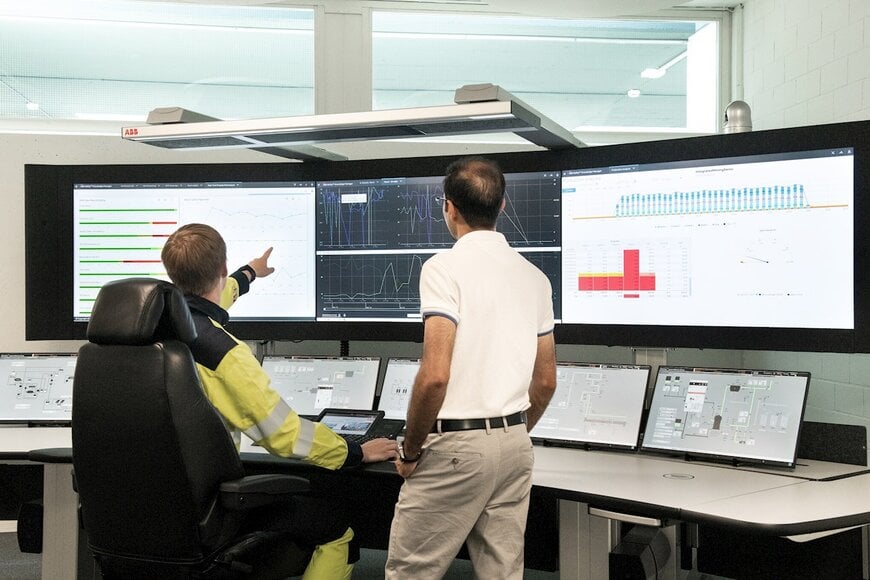
To resolve process instability and reduce energy intensity, Tokuyama implemented advanced process control technologies utilizing model predictive control and artificial intelligence algorithms. The system was engineered to predict process dynamics continuously and make automated adjustments to key parameters, including material feed rates and mill power settings.
Following an initial installation on a cement kiln in 2022, the facility initiated a pilot deployment on a single finish mill in 2024. Based on performance verification, the installation was expanded across six additional grinding units, encompassing a total of seven finish mills: four cement ball mills and two vertical roller mills dedicated to pre-grinding and slag processing. The technology provider coordinated the commissioning phases directly around the plant's active production schedules to prevent operational disruption.
Operational Stability and Energy Efficiency Gains
The installation established automated closed-loop control across the mill lines, exceeding an automatic operation rate of 90 percent. Continuous optimization of mill loading and feed rates delivered a 3 percent increase in grinding throughput alongside a 3 percent reduction in specific electrical power consumption across the finish grinding circuits.
On the thermal side, the kiln implementation resulted in a 3 percent decrease in specific heat consumption and reduced manual operator interventions by 70 percent. By shifting routine adjustments from human operators to the predictive control system, the facility standardized production parameters, mitigated mechanical stress from operational fluctuations, and established a stable baseline for autonomous plant operations.
"When we first introduced the system for test purposes, results were clear and the project completed smoothly," said Junya Doi of the Engineering Section, Cement Manufacturing Department at Tokuyama. "We decided to extend the use of the solution to the entire cement mill process. ABB has been a reliable partner, collaborating effectively to fit the operating schedules."
Technical specialists noted that the system emulates expert operator decisions while systematically identifying operational setpoints that individual manual control cannot sustain continuously.
"The system has delivered a level of control at Nanyo plant that can not only emulate operator actions but enable process stabilization and optimization at the same time," said Hiromichi Yoda, Local Division Manager for Japan, Process Industries division at ABB.
The deployment demonstrates the operational impact of integrating predictive digital control models into legacy heavy industrial assets, securing measurable energy savings without requiring mechanical retrofits of the grinding equipment.
Edited by Sucithra Mani, Induportals editor – adapted by AI.
www.abb.com
