
www.industry-asia-pacific.com
19
'26
Written on Modified on
Optimizing Precision Cutting in Semiconductor Wafer Processing
Leddo Technology has integrated PC-based control and EtherCAT communication to increase the accuracy and yield rate of its automated dicing saws.
www.beckhoff.com
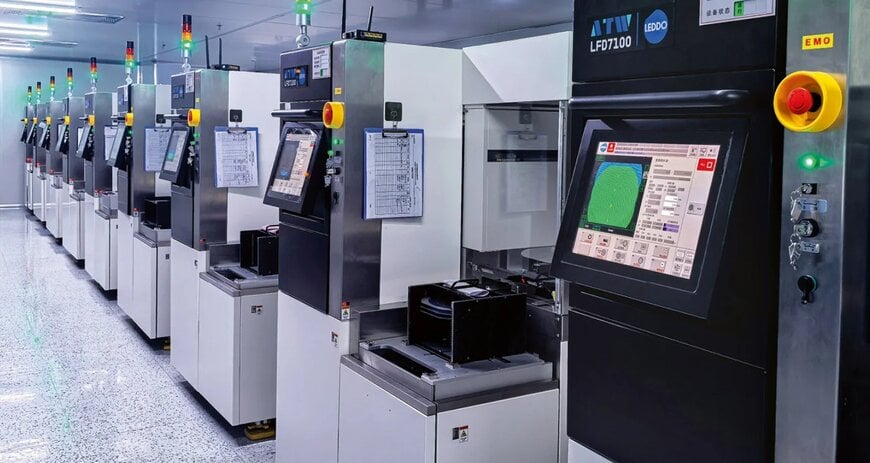
The global demand for electronic components requires manufacturing equipment to deliver high throughput while maintaining strict quality standards. In semiconductor back-end processing, dicing saws must cut valuable materials — such as silicon, lithium niobate, ceramics, glass, and quartz — into individual chips without damaging the delicate structures.
For its LAD5100 single-axis semi-automatic and LFD7100 dual-axis fully automatic dicing saws, Leddo Technology needed an automation platform capable of managing high-speed spindle rotation alongside micro-meter level positioning. The main challenge involved minimizing processing cycle times and reducing vibration to prevent cutting defects, which directly impact the final yield rate of wafers ranging from 6 to 12 inches.
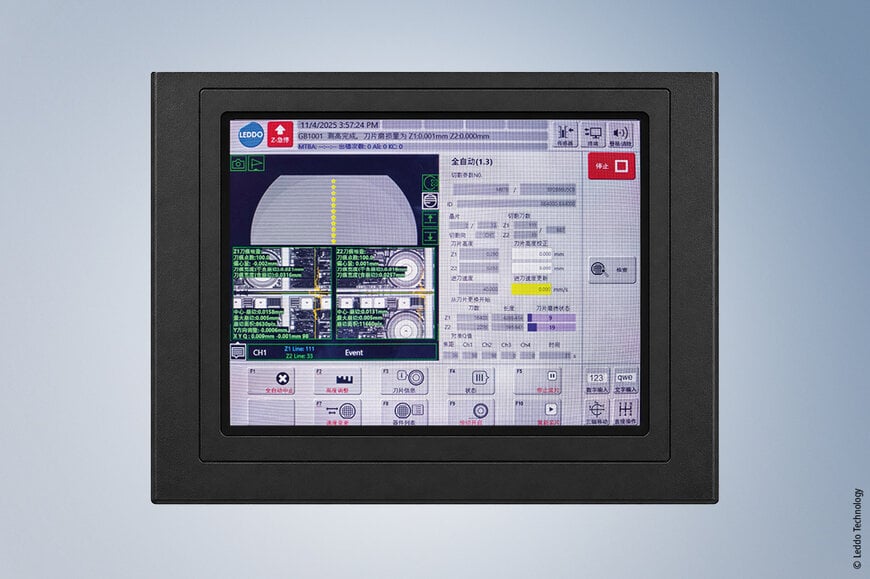
HMI with a visualization of the dicing process and machine parameters
Open Control Architecture and Real-Time Synchronization
To meet these operational demands, the company implemented a universal PC- and EtherCAT-based control platform from Beckhoff. The hardware backbone consists of a C6030 ultra-compact Industrial PC equipped with an Intel Core i5 processor. This controller achieves task cycle times of 50 μs and features four independent Gigabit Ethernet ports to support EtherCAT real-time communication alongside standard protocols like Modbus TCP and TCP/IP.
The machine control logic runs on Windows 10 IoT Enterprise, while the human-machine interface (HMI) was developed in C#. This PC-based architecture consolidates control tasks onto a single platform, reducing hardware components and lowering overall equipment costs.
The selection of the EtherCAT fieldbus system provides nanosecond-level synchronization across the machine nodes. This rapid response time eliminates delays between sequential processing steps. For data acquisition, the system utilizes a range of EtherCAT Terminals, including the EL3702 analog input terminal. This module features an oversampling function that allows high-resolution scanning of the measurement range, ensuring precise feedback from the cutting area.
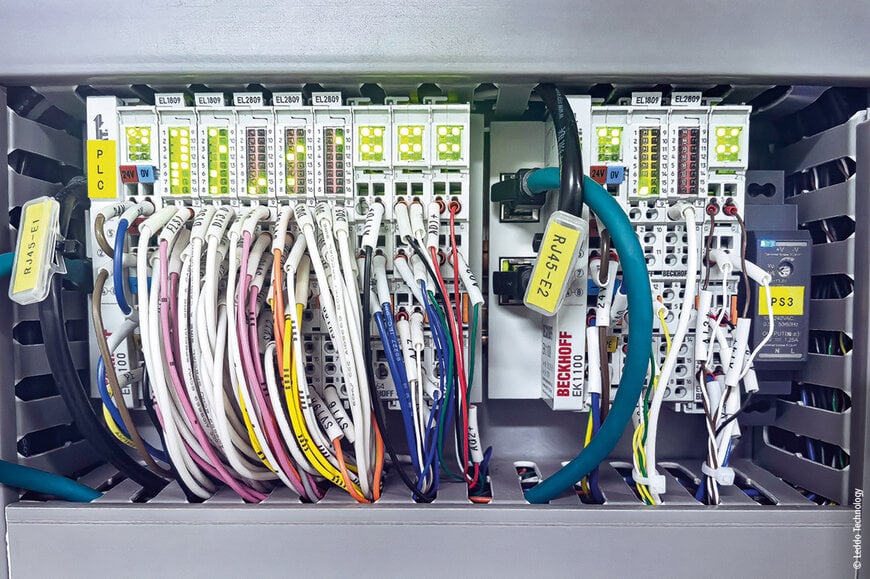
The compact I/O level equipped with EtherCAT Terminals saves space in in the machine-integrated control cabinet.
Multitasking Software for Motion and Condition Monitoring
Software integration is managed via TwinCAT 3, which combines PLC and motion control functions into a unified development and runtime environment. The software allows the assignment of different task cycles to specific CPU cores with flexible priority settings for real-time multi-task processing.
This processing power is critical for the coordinated motion control of the cutting axes and the spindle drive. The numerical control (NC) cycle time reaches 200 μs, supporting the following technical parameters:
- Y-axis single positioning accuracy: Up to 0.002 mm per 5 mm travel
- Y-axis full-range positioning accuracy: 0.003 mm per 310 mm travel
- Z-axis travel resolution: 0.00005 mm for the dicing blade
- Repeat positioning accuracy: 0.001 mm
- Maximum spindle speed: 60,000 rpm with a radial runout under 0.1 μm
To maintain machine availability, specific software libraries are used for diagnostics and preventative maintenance. The TwinCAT 3 Eventlogger records customized alarm information, while the TwinCAT 3 Scope Server automatically collects real-time data for analysis. Additionally, TwinCAT 3 Condition Monitoring evaluates vibration measurement data during the cutting process, allowing the system to compensate for mechanical instability before it impacts cutting quality.
Measurable Efficiency and Yield Improvements
The implementation of the PC-based control and EtherCAT architecture resulted in a cutting accuracy of ±1.5 μm. In production environments, this precision allows the yield rate for processed semiconductor materials to exceed 99.9%, reducing raw material waste.
From a maintenance perspective, the integrated diagnostic capabilities of the software simplify commissioning and troubleshooting by accelerating error localization. Furthermore, the compact form factor of the industrial PC and the modular I/O terminals reduces the required space inside the control cabinet, minimizing the overall footprint of the machine within costly cleanroom production environments.
Edited by Evgeny Churilov, Induportals Media - Adapted by AI.
www.beckhoff.com
Measurable Efficiency and Yield Improvements
The implementation of the PC-based control and EtherCAT architecture resulted in a cutting accuracy of ±1.5 μm. In production environments, this precision allows the yield rate for processed semiconductor materials to exceed 99.9%, reducing raw material waste.
From a maintenance perspective, the integrated diagnostic capabilities of the software simplify commissioning and troubleshooting by accelerating error localization. Furthermore, the compact form factor of the industrial PC and the modular I/O terminals reduces the required space inside the control cabinet, minimizing the overall footprint of the machine within costly cleanroom production environments.
Edited by Evgeny Churilov, Induportals Media - Adapted by AI.
www.beckhoff.com
